Beyond Teknoloji Unveils Bazna Kamikaze Drone at SAHA 2026
Beyond Teknoloji introduced the Bazna series of kamikaze drones at SAHA 2026, featuring anti-jamming capabilities, water resistance, and a 25-minute flight time. The drone is designed for all-weather operations including rain, sea, and mountainous terrain.

Beyond Teknoloji presented its new Bazna series of kamikaze drones at the SAHA 2026 exhibition. The platform is engineered to operate in challenging environmental conditions, including rain, sea spray, and high-altitude terrain. Company representatives highlighted the drone's resilience against adverse weather during the unveiling.
The Bazna drone incorporates anti-jamming technology to maintain control in contested electromagnetic environments. It is built with water-resistant materials, allowing it to function in wet conditions and over maritime areas. The system offers a flight time of up to 25 minutes per mission.
Designed as a loitering munition, the Bazna can loiter over a target area before engaging. The drone's compact form factor enables rapid deployment from various platforms. Beyond Teknoloji emphasized the system's ease of use and portability for field operations.
The drone's navigation suite includes GPS and inertial guidance, with the anti-jam feature ensuring reliable operation even when GPS signals are disrupted. The water-resistant design protects internal components from moisture and saltwater exposure.
Beyond Teknoloji stated that the Bazna series is intended for military and security applications requiring persistent surveillance and precision strike capabilities. The drone can be integrated with existing command and control systems.
Pricing and specific technical specifications were not disclosed at the event. The company confirmed that the Bazna is available for order and will be delivered to customers following testing and certification.
The SAHA 2026 exhibition, held in Istanbul, serves as a platform for defense and aerospace companies to showcase new technologies. Beyond Teknoloji's Bazna drone attracted attention from international delegations attending the fair.
Beyond Teknoloji officials said the Bazna represents a new category of all-weather kamikaze drones designed for modern battlefield requirements. The company plans to demonstrate the system's capabilities in live-fire exercises later this year.
AV2 Codec Final Version Reportedly Set for May 2026 Release
The next-generation AV2 codec standard is nearing its final release, with a leaked timeline indicating the official 1.0 version may launch in May 2026. The codec aims to succeed AV1 with improved compression efficiency.
The successor to the AV1 video codec, AV2, is approaching its final release. According to leaked information, the official 1.0 version of AV2 could be published in May 2026. The timeline suggests the codec is moving closer to standardization after years of development.
AV2 is being developed by the Alliance for Open Media (AOM), the same consortium behind AV1. The group includes major technology companies such as Google, Apple, Microsoft, Netflix, and Amazon. The new codec is designed to offer better compression efficiency than its predecessor, enabling higher quality video at lower bitrates.
Early development of AV2 began around 2018, with exploratory work on next-generation coding tools. The codec incorporates advanced techniques such as neural network-based coding and improved motion compensation. These features aim to reduce file sizes by up to 30% compared to AV1 while maintaining similar visual quality.
The leaked release date comes from a public AOM meeting agenda, which listed the AV2 1.0 specification as a target for May 2026. The agenda also included discussions on finalizing the bitstream format and reference software. AOM has not officially confirmed the date, but the document suggests the consortium is on track to meet that deadline.
AV2 is expected to be royalty-free, following the same licensing model as AV1. This approach has made AV1 popular among streaming services and web browsers, though adoption has been gradual due to encoding complexity. AV2 aims to address some of those challenges with more efficient encoding algorithms.
Streaming platforms and hardware manufacturers are likely to begin integrating AV2 support after the final specification is released. Software encoders and decoders are expected to follow, with hardware acceleration possibly arriving in later generations of GPUs and mobile chips. The transition from AV1 to AV2 is anticipated to take several years.
For now, the May 2026 target remains unofficial. AOM has not issued a public statement regarding the release schedule. The leaked agenda indicates the consortium is working toward that date, but delays are possible as the technical details are finalized.
If the timeline holds, AV2 will mark a significant step forward in video compression technology. The codec's improved efficiency could benefit streaming services, video conferencing, and other bandwidth-sensitive applications. The final specification is expected to be published on the AOM website upon release.
Huawei Unveils 61 TB and 122 TB SSD Storage Units Despite Sanctions
Huawei announced new SSD storage units with capacities of 61 TB and 122 TB, leveraging proprietary packaging technology to achieve high density. The launch comes amid ongoing U.S. sanctions against the company.
Huawei has introduced two new solid-state drive storage units, offering 61 TB and 122 TB capacities. The announcement was made despite the company continuing to face U.S. sanctions that restrict its access to certain technologies. Huawei stated that the new SSDs utilize a proprietary packaging technology to achieve these high storage densities.
The 61 TB and 122 TB drives are designed for enterprise data centers and large-scale storage applications. Huawei claims the packaging method allows for more NAND flash chips to be stacked in a compact form factor, increasing capacity without expanding physical size. The company did not disclose the specific NAND type or controller used in the drives.
Huawei has been developing its own storage solutions to reduce reliance on foreign suppliers amid trade restrictions. The new SSDs are part of the company's broader strategy to strengthen its data center infrastructure offerings. Huawei's storage division has been investing heavily in research and development to create competitive products.
The 61 TB model is expected to target mid-range enterprise storage needs, while the 122 TB version aims at high-capacity applications such as big data analytics and cloud storage. Huawei emphasized that the drives meet industry standards for reliability and performance, though specific read/write speeds and endurance ratings were not provided.
Analysts note that achieving such high capacities is technically challenging, especially under the constraints of U.S. export controls. Huawei's ability to produce these SSDs suggests progress in its domestic supply chain efforts. However, the company may face hurdles in mass production and market adoption due to ongoing geopolitical tensions.
Pricing and availability details for the new SSDs have not been announced. Huawei indicated that the drives are currently being sampled to select customers and will enter volume production later this year. The company plans to showcase the products at upcoming industry events.
Huawei's storage business has been a bright spot amid declining smartphone sales. The company reported growth in its enterprise segment, driven by demand for data center solutions. The new SSDs are expected to strengthen Huawei's position in the global storage market, though competition from established players like Samsung and Western Digital remains intense.
Huawei stated that the 61 TB and 122 TB SSDs represent a milestone in its storage technology development. The company reaffirmed its commitment to innovation despite external challenges, and said it will continue to invest in next-generation storage solutions.

Amazfit Bip Max Launches with High-End Specs in Square Smartwatch Design
Amazfit has introduced the Bip Max, a square smartwatch packing top-tier specifications at a competitive price. The device features a 1.97-inch AMOLED display, GPS, and up to 14 days of battery life.
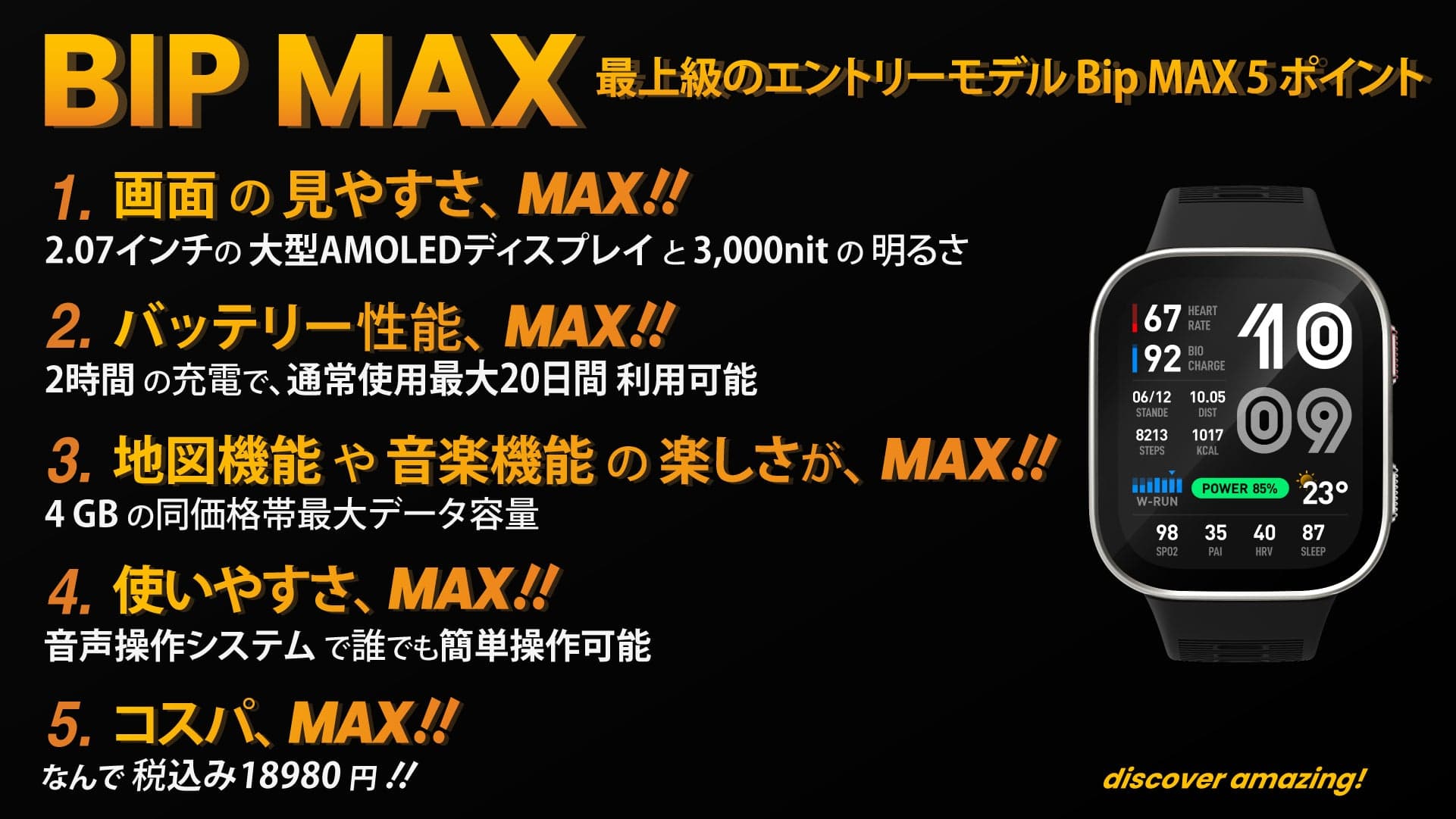
Amazfit, a brand under Zepp Health Corporation, has unveiled the Bip Max, a new square smartwatch that brings high-end specifications to an affordable price point. The device was announced on March 20, 2025, and is now available for purchase in Japan. The Bip Max aims to redefine expectations for square-shaped smartwatches by offering features typically found in premium models.
The Bip Max features a 1.97-inch AMOLED display with a resolution of 390x450 pixels, providing sharp and vibrant visuals. The screen is protected by Corning Gorilla Glass and supports an always-on display mode. The watch case is made of aluminum alloy, giving it a premium feel while keeping the weight at just 39 grams without the strap.
Under the hood, the Bip Max is powered by a new chipset that enables smooth performance and efficient power management. It includes built-in GPS, GLONASS, and BeiDou satellite positioning systems for accurate outdoor tracking. The watch also features a heart rate sensor, SpO2 monitor, and sleep tracking capabilities. Amazfit claims the Bip Max can last up to 14 days on a single charge under typical usage, and up to 30 days in battery saver mode.
The smartwatch runs on Amazfit's proprietary operating system, which is compatible with both Android and iOS devices. It supports notifications for calls, messages, and apps, as well as music control and remote camera shutter. The Bip Max includes over 100 watch faces and supports custom watch faces via the Zepp app. It also has a 5ATM water resistance rating, making it suitable for swimming and showering.
In terms of health and fitness tracking, the Bip Max offers more than 100 sports modes, including running, cycling, swimming, and yoga. It provides detailed analysis of workout data, such as heart rate zones, pace, and distance. The watch also includes a stress monitoring feature and breathing exercises to help users manage their well-being.
The Amazfit Bip Max is priced at 19,800 yen (approximately $135 USD) in Japan. It is available in two color options: Midnight Black and Moonlight White. The device comes with a silicone strap and a magnetic charging cable. Amazfit is offering a limited-time promotion that includes a free extra strap with purchase.
Zepp Health Corporation stated that the Bip Max combines the classic square design with modern technology, offering users a versatile smartwatch experience without compromising on features. The company emphasized that the device targets consumers who prefer a square watch face but want high-end specifications typically reserved for round smartwatches.
The Amazfit Bip Max is now available for purchase through Amazfit's official website and select retailers in Japan. International availability has not been announced yet, but the company may expand to other markets in the future. The device comes with a one-year warranty and standard return policy.
KFintech unveils AEGIX, an AI-driven investor relations platform for listed firms
KFintech has launched AEGIX, an AI-powered investor relations platform designed for listed companies. The platform aims to streamline communication between companies and their investors using artificial intelligence.
KFintech, a financial technology company, has introduced AEGIX, a new investor relations platform powered by artificial intelligence. The platform is tailored for listed companies seeking to enhance their engagement with investors. AEGIX leverages AI to automate and optimize various aspects of investor relations, including data analysis, reporting, and communication.
The platform offers features such as real-time analytics, sentiment analysis, and automated report generation. It integrates with existing systems to provide a unified view of investor interactions. Companies can use AEGIX to track investor behavior, monitor market sentiment, and generate insights for strategic decision-making.
KFintech developed AEGIX in response to the growing demand for digital tools in investor relations. The platform aims to reduce manual effort and improve accuracy in managing investor communications. It also provides compliance support by ensuring that disclosures and communications adhere to regulatory requirements.
The launch comes as KFintech shares traded at ₹816.15 on Thursday, down 1.44% from the previous close of ₹828.05, with a market capitalisation of approximately ₹14,090 crore. The company's stock has been under pressure in recent trading sessions.
AEGIX is available immediately for listed companies in India. KFintech plans to expand the platform's capabilities over time, adding more AI-driven features. The company has not disclosed pricing details for the platform.
KFintech's foray into AI-powered investor relations reflects a broader trend in the financial services industry, where firms are increasingly adopting technology to improve efficiency and client engagement. The platform is expected to compete with other digital investor relations solutions in the market.
KFintech stated that AEGIX represents a significant step in its product development strategy. The company aims to strengthen its position as a technology provider for the capital markets ecosystem.