Google Unveils Gemini-Powered Smart Glasses at I/O 2024
Google introduced AI-powered smart glasses at its I/O developer conference, integrating the Gemini AI system for real-time assistance. The glasses offer features like navigation, dining suggestions, and smart home control via voice commands.

Google announced a new pair of smart glasses at its annual I/O developer conference, embedding the company's Gemini AI system directly into the eyewear. The device is designed to provide real-time, context-aware assistance to users throughout their day. Google positioned the glasses as a more advanced alternative to existing products like Meta's Ray-Ban Stories.
The glasses leverage Gemini's multimodal capabilities to process visual and audio inputs simultaneously. Users can receive turn-by-turn navigation overlays, personalized restaurant recommendations based on their preferences and location, and control smart home devices through voice commands. The AI can also identify objects and landmarks in the user's field of view.
Google demonstrated several use cases during the keynote, including the glasses suggesting a nearby coffee shop when the user expressed thirst and providing historical facts about a building the user was looking at. The device uses bone conduction speakers for audio feedback, keeping the user's ears open to ambient sounds.
Unlike earlier Google Glass iterations, these new glasses are designed for everyday wear with a more discreet form factor. The frames come in multiple colors and can be fitted with prescription lenses. Google emphasized privacy features, including a visible LED indicator when the camera is recording and a physical shutter for the camera.
The glasses connect to a companion smartphone app for setup and data syncing. Google said the device will support third-party app integrations through the Gemini API, allowing developers to build custom experiences. Battery life is rated at a full day of typical use, with a charging case that provides additional charges.
Pricing and availability details were not disclosed during the presentation. Google stated the glasses are still in a prototype phase and will be released to developers first, with a consumer launch expected later. The company did not provide a specific release date or price range.
Google's announcement comes as the smart glasses market sees renewed interest from major tech companies. Meta's Ray-Ban Stories have sold modestly, while Apple is reportedly working on its own AR glasses. Google's earlier Google Glass Explorer Edition faced privacy backlash and was discontinued in 2015.
Google said the Gemini smart glasses represent a significant step forward in wearable AI, combining natural language understanding with computer vision. The company plans to share more technical details and developer tools in the coming months. Developers can sign up for early access on Google's website.
Amazfit Bip Max Launches with High-End Specs in Square Smartwatch Design
Amazfit has introduced the Bip Max, a square smartwatch packing top-tier specifications at a competitive price. The device features a 1.97-inch AMOLED display, GPS, and up to 14 days of battery life.
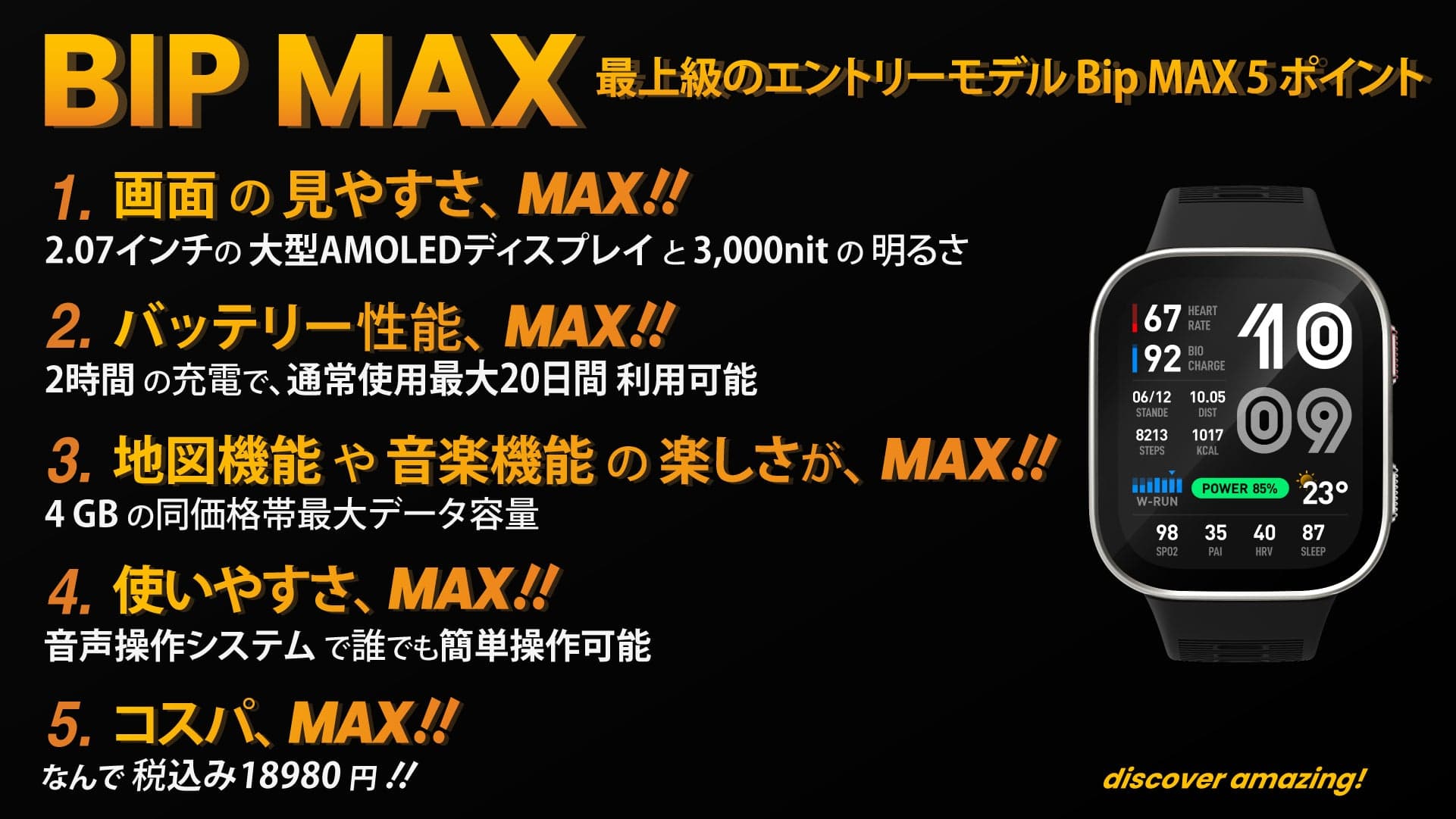
Amazfit, a brand under Zepp Health Corporation, has unveiled the Bip Max, a new square smartwatch that brings high-end specifications to an affordable price point. The device was announced on March 20, 2025, and is now available for purchase in Japan. The Bip Max aims to redefine expectations for square-shaped smartwatches by offering features typically found in premium models.
The Bip Max features a 1.97-inch AMOLED display with a resolution of 390x450 pixels, providing sharp and vibrant visuals. The screen is protected by Corning Gorilla Glass and supports an always-on display mode. The watch case is made of aluminum alloy, giving it a premium feel while keeping the weight at just 39 grams without the strap.
Under the hood, the Bip Max is powered by a new chipset that enables smooth performance and efficient power management. It includes built-in GPS, GLONASS, and BeiDou satellite positioning systems for accurate outdoor tracking. The watch also features a heart rate sensor, SpO2 monitor, and sleep tracking capabilities. Amazfit claims the Bip Max can last up to 14 days on a single charge under typical usage, and up to 30 days in battery saver mode.
The smartwatch runs on Amazfit's proprietary operating system, which is compatible with both Android and iOS devices. It supports notifications for calls, messages, and apps, as well as music control and remote camera shutter. The Bip Max includes over 100 watch faces and supports custom watch faces via the Zepp app. It also has a 5ATM water resistance rating, making it suitable for swimming and showering.
In terms of health and fitness tracking, the Bip Max offers more than 100 sports modes, including running, cycling, swimming, and yoga. It provides detailed analysis of workout data, such as heart rate zones, pace, and distance. The watch also includes a stress monitoring feature and breathing exercises to help users manage their well-being.
The Amazfit Bip Max is priced at 19,800 yen (approximately $135 USD) in Japan. It is available in two color options: Midnight Black and Moonlight White. The device comes with a silicone strap and a magnetic charging cable. Amazfit is offering a limited-time promotion that includes a free extra strap with purchase.
Zepp Health Corporation stated that the Bip Max combines the classic square design with modern technology, offering users a versatile smartwatch experience without compromising on features. The company emphasized that the device targets consumers who prefer a square watch face but want high-end specifications typically reserved for round smartwatches.
The Amazfit Bip Max is now available for purchase through Amazfit's official website and select retailers in Japan. International availability has not been announced yet, but the company may expand to other markets in the future. The device comes with a one-year warranty and standard return policy.
KFintech unveils AEGIX, an AI-driven investor relations platform for listed firms
KFintech has launched AEGIX, an AI-powered investor relations platform designed for listed companies. The platform aims to streamline communication between companies and their investors using artificial intelligence.
KFintech, a financial technology company, has introduced AEGIX, a new investor relations platform powered by artificial intelligence. The platform is tailored for listed companies seeking to enhance their engagement with investors. AEGIX leverages AI to automate and optimize various aspects of investor relations, including data analysis, reporting, and communication.
The platform offers features such as real-time analytics, sentiment analysis, and automated report generation. It integrates with existing systems to provide a unified view of investor interactions. Companies can use AEGIX to track investor behavior, monitor market sentiment, and generate insights for strategic decision-making.
KFintech developed AEGIX in response to the growing demand for digital tools in investor relations. The platform aims to reduce manual effort and improve accuracy in managing investor communications. It also provides compliance support by ensuring that disclosures and communications adhere to regulatory requirements.
The launch comes as KFintech shares traded at ₹816.15 on Thursday, down 1.44% from the previous close of ₹828.05, with a market capitalisation of approximately ₹14,090 crore. The company's stock has been under pressure in recent trading sessions.
AEGIX is available immediately for listed companies in India. KFintech plans to expand the platform's capabilities over time, adding more AI-driven features. The company has not disclosed pricing details for the platform.
KFintech's foray into AI-powered investor relations reflects a broader trend in the financial services industry, where firms are increasingly adopting technology to improve efficiency and client engagement. The platform is expected to compete with other digital investor relations solutions in the market.
KFintech stated that AEGIX represents a significant step in its product development strategy. The company aims to strengthen its position as a technology provider for the capital markets ecosystem.
Kiyoshi Kurosawa’s ‘The Samurai and the Prisoner’ Review: Shogun-Era Drama with Nesting Mysteries
Kiyoshi Kurosawa adapts a literary work into a classical shogun-era drama, weaving multiple mysteries into an elegant narrative. The film explores themes of honor and discontent in feudal Japan.

Kiyoshi Kurosawa’s latest film, “The Samurai and the Prisoner,” is a literary adaptation that brings a classical shogun-era drama to the screen. The veteran filmmaker crafts an absorbing narrative set during a period of swirling discontent in Japanese history. The story unfolds with a heavy sense of duty and honor, embodied by the samurai protagonist.
The film centers on a samurai who carries the weight of his topknot, a symbol of his station and responsibilities. Kurosawa folds nesting mysteries into the plot, each layer revealing deeper complexities. The narrative is clean-lined, avoiding unnecessary embellishments while maintaining a rich atmosphere.
Set in feudal Japan, the drama explores the tensions within a society on the brink of change. The samurai’s journey intersects with a prisoner, whose presence triggers a series of revelations. Kurosawa’s direction emphasizes subtle performances and meticulous period detail.
The film’s pacing is deliberate, allowing the mysteries to unfold organically. Kurosawa avoids modern sensibilities, instead embracing the conventions of classical Japanese cinema. The result is a work that feels both timeless and fresh.
“The Samurai and the Prisoner” premiered at international film festivals to critical acclaim. The cast delivers strong performances, with particular praise for the lead actor’s portrayal of the conflicted samurai. The cinematography captures the stark beauty of the Japanese landscape.
The film is currently in limited theatrical release, with plans for a wider rollout in the coming weeks. Distributors have secured rights for multiple territories, including North America and Europe. A streaming release is expected later this year.
Kurosawa’s adaptation stays faithful to its source material while adding his signature touch. The film has been praised for its elegant storytelling and nuanced character development. It stands as a notable addition to the director’s diverse filmography.
“The Samurai and the Prisoner” is now playing in select theaters. The film runs 130 minutes and is rated R for violence and thematic content.
French Navy's Second FDI Frigate Amiral Louzeau Launched with Greek Industry Involvement
Salamis Shipyards announced the launch of the second FDI frigate for the French Navy, Amiral Louzeau, highlighting significant Greek industrial participation. The event marks a milestone for Greek shipbuilding.

Salamis Shipyards has confirmed the launch of the second FDI frigate destined for the French Navy, named Amiral Louzeau. The shipyard described the event as a particularly significant development for the Greek shipbuilding industry, emphasizing the role of Greek companies in the project. The frigate's construction involved substantial contributions from Greek industrial partners, underscoring the country's growing capabilities in naval defense manufacturing.
The FDI (Frégate de Défense et d'Intervention) program is a French naval initiative aimed at producing advanced multi-mission frigates. Amiral Louzeau is the second vessel in this series, following the lead ship Amiral Ronarc'h. The frigates are designed for anti-submarine warfare, anti-surface warfare, and air defense, equipped with state-of-the-art sensors and weapon systems.
Greek industry participation in the FDI program includes the supply of key components and systems. Salamis Shipyards, based in Salamis Island, Greece, has been involved in the construction and outfitting of the frigate. The collaboration highlights the integration of Greek defense contractors into major European naval projects.
The launch ceremony took place at the Salamis Shipyards facility, attended by officials from the French Navy, Greek government representatives, and industry executives. The frigate will now undergo sea trials and final outfitting before delivery to the French Navy, expected within the next year.
Amiral Louzeau is named after a French naval officer, continuing the tradition of honoring historical figures in the French Navy. The vessel measures approximately 122 meters in length and displaces around 4,500 tons. It will be armed with Exocet anti-ship missiles, Aster surface-to-air missiles, and a 76mm main gun, among other systems.
For Greece, the involvement in the FDI program represents a strategic opportunity to bolster its own naval capabilities and industrial base. The Greek Navy is also modernizing its fleet, and the experience gained from this collaboration could inform future domestic projects.
The French Navy plans to acquire a total of five FDI frigates, with the third vessel, Amiral Castex, currently under construction. The program is part of France's broader naval modernization efforts, replacing older classes of frigates.
Salamis Shipyards stated that the successful launch of Amiral Louzeau demonstrates the high quality of Greek shipbuilding and its ability to meet international standards. The company expressed hope for continued partnerships with European navies.