Google Updates Spam Policy to Target AI Manipulation in Search Results
Google has revised its spam policies to explicitly prohibit techniques aimed at manipulating its AI-powered search features, including AI Overview and AI Mode. The update targets practices like 'recommendation poisoning' and biased listicles designed to influence generative AI responses.

Google has updated its spam policy to explicitly prohibit attempts to manipulate its artificial intelligence models within search results, including AI Overview and AI Mode in Search. The company announced the change, stating that spam now encompasses techniques used to deceive users or manipulate search systems into featuring content prominently, with a specific focus on manipulating generative AI responses. This move comes as users have increasingly tried to influence AI-generated search summaries through tactics such as biased 'best-of' listicles and 'recommendation poisoning,' which injects misleading data into language model outputs.
The updated policy defines spam as any attempt to manipulate Google's search systems, including AI-driven features, to rank content higher or generate favorable AI responses. Google's search liaison, Danny Sullivan, emphasized that the policy already covered many such practices but has been clarified to address emerging threats to AI-generated content. The company aims to ensure that AI Overviews and AI Mode provide accurate, unbiased information rather than being swayed by coordinated efforts to game the system.
'Recommendation poisoning' involves creating content specifically designed to influence the training data or real-time outputs of large language models, often by embedding false or skewed recommendations within seemingly legitimate articles. Similarly, biased listicles may rank products or services not based on merit but to manipulate AI summaries that pull from such lists. These tactics exploit how AI models aggregate and summarize web content, potentially leading to misleading search results.
Google's clarification aligns with its broader efforts to maintain search quality amid the rise of generative AI. The company has faced criticism over AI Overviews producing inaccurate or bizarre answers, partly due to reliance on low-quality sources. By explicitly banning manipulation of AI systems, Google aims to curb the spread of misinformation and preserve trust in its search features. This update also reflects a growing industry concern over adversarial attacks on AI models.
The new policy applies globally to all Google Search features, including AI Overviews, which are currently available in over 100 countries. For users, this means attempts to artificially boost rankings or skew AI responses could result in penalties, including reduced visibility or removal from search results. Businesses and content creators should review their strategies to ensure compliance, particularly those using listicles or recommendation-heavy content.
While Google has not detailed specific enforcement mechanisms, it relies on automated systems and manual reviews to detect spam. The company encourages users to report suspicious content that appears to manipulate AI outputs. As AI-generated search features expand, such policies are likely to evolve further to address new manipulation techniques.
Moving forward, Google may refine its spam detection algorithms to identify patterns indicative of AI manipulation. The company is also exploring ways to make AI Overviews more transparent about their sources. However, the effectiveness of these measures will depend on ongoing monitoring and adaptation as malicious actors develop new tactics.
One of Intel’s fastest desktop CPUs is $50 off
This development in AI News signals new momentum in the technology agenda.

One of Intel’s fastest desktop CPUs is $50 off has become a significant development in the technology sector. This advancement signals new momentum in the ai haberleri space and carries important implications for both consumers and industry players.
The technical details surrounding this announcement suggest a deliberate strategy aimed at capturing market share while addressing existing user pain points. Industry analysts note that the timing of this release aligns with broader shifts in how technology is adopted at scale.
From a competitive standpoint, this move places additional pressure on established players who have dominated the segment for years. The introduction of these features could force rivals to accelerate their own roadmaps or risk losing relevance in an increasingly crowded marketplace.
Consumer reactions have been mixed but generally positive, with early adopters highlighting the practical benefits over marketing promises. The focus appears to be on solving real problems rather than introducing novelty for its own sake.
Looking at the broader ecosystem, this development may trigger ripple effects across adjacent categories. Partnerships, supply chains, and developer communities are all likely to feel the impact as adoption scales.
Whether this represents a lasting shift or a temporary market reaction will depend on execution quality and sustained innovation in the coming quarters.}
OpenAI to Let ChatGPT Access Your Bank Accounts via Plaid Integration
OpenAI is introducing a new feature that allows ChatGPT to securely connect with users' financial accounts through Plaid, enabling the chatbot to provide personalized financial advice. The integration, announced in preview, will give ChatGPT access to banking data from over 12,000 financial institutions.
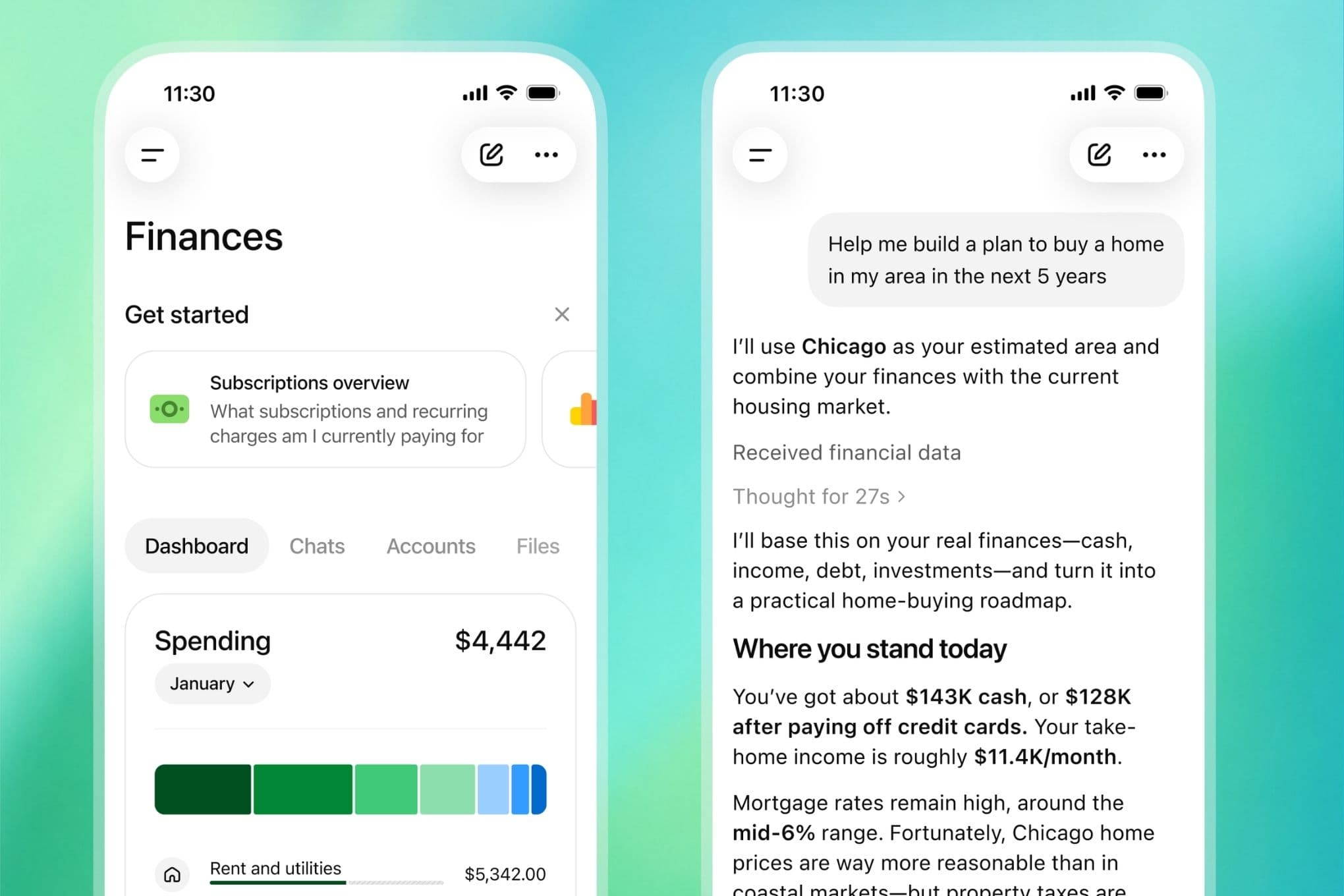
OpenAI has announced a new feature that will allow ChatGPT to directly access users' bank accounts, marking a significant expansion of the chatbot's capabilities. The feature, currently in preview, enables users to securely connect their financial accounts with Plaid, a platform that bridges bank accounts with various apps and services. This integration will give ChatGPT a comprehensive view of users' financial situations, including credit card debt, account balances, and transaction history.
To use the feature, ChatGPT users will need to link their financial accounts through Plaid, which supports over 12,000 financial institutions, including major banks like Schwab, Fidelity, Chase, and Capital One. Once connected, ChatGPT can analyze the user's financial data to offer personalized advice on budgeting, saving, and spending. OpenAI emphasizes that the connection is secure, with Plaid handling the authentication and data transfer.
The move comes as OpenAI notes that more than 200 million people monthly ask ChatGPT finance-related questions, from budgeting tips to advice on reducing expenses. By integrating with Plaid, OpenAI aims to provide more accurate and tailored responses, moving beyond generic advice to insights based on the user's actual financial data. This could include identifying spending patterns, suggesting savings goals, or flagging potential overdraft risks.
This development places OpenAI in direct competition with existing financial management apps and services, such as Mint or YNAB, which already use Plaid to aggregate financial data. However, ChatGPT's conversational interface could offer a more intuitive way for users to interact with their finances. The feature also raises questions about privacy and data security, as users must trust OpenAI with sensitive financial information.
Currently, the feature is available only to a limited number of users as part of a preview. OpenAI has not announced a wide release date or pricing details. The company has stated that user data will be handled according to its privacy policies, and users can revoke access at any time. Plaid's existing security measures, including encryption and multi-factor authentication, will apply.
The integration is expected to roll out gradually, with OpenAI likely monitoring user feedback and addressing any security concerns before a broader launch. Future iterations could include more sophisticated financial planning tools, such as retirement savings projections or investment advice. However, regulatory hurdles may arise, as financial advice often requires compliance with specific regulations.
As AI continues to permeate personal finance, the partnership between OpenAI and Plaid represents a significant step toward more integrated and personalized financial management. Users interested in the feature can sign up for the preview on OpenAI's website, though availability may be limited. The success of this initiative will depend on user trust and the ability to deliver accurate, helpful financial guidance.
AI radio hosts demonstrate why AI can’t be trusted alone
This development in AI News signals new momentum in the technology agenda.

AI radio hosts demonstrate why AI can’t be trusted alone has become a significant development in the technology sector. This advancement signals new momentum in the ai haberleri space and carries important implications for both consumers and industry players.
The technical details surrounding this announcement suggest a deliberate strategy aimed at capturing market share while addressing existing user pain points. Industry analysts note that the timing of this release aligns with broader shifts in how technology is adopted at scale.
From a competitive standpoint, this move places additional pressure on established players who have dominated the segment for years. The introduction of these features could force rivals to accelerate their own roadmaps or risk losing relevance in an increasingly crowded marketplace.
Consumer reactions have been mixed but generally positive, with early adopters highlighting the practical benefits over marketing promises. The focus appears to be on solving real problems rather than introducing novelty for its own sake.
Looking at the broader ecosystem, this development may trigger ripple effects across adjacent categories. Partnerships, supply chains, and developer communities are all likely to feel the impact as adoption scales.
Whether this represents a lasting shift or a temporary market reaction will depend on execution quality and sustained innovation in the coming quarters.}
Does Trump Mobile know how many stripes are on the American flag?
This development in AI News signals new momentum in the technology agenda.

Does Trump Mobile know how many stripes are on the American flag? has become a significant development in the technology sector. This advancement signals new momentum in the ai haberleri space and carries important implications for both consumers and industry players.
The technical details surrounding this announcement suggest a deliberate strategy aimed at capturing market share while addressing existing user pain points. Industry analysts note that the timing of this release aligns with broader shifts in how technology is adopted at scale.
From a competitive standpoint, this move places additional pressure on established players who have dominated the segment for years. The introduction of these features could force rivals to accelerate their own roadmaps or risk losing relevance in an increasingly crowded marketplace.
Consumer reactions have been mixed but generally positive, with early adopters highlighting the practical benefits over marketing promises. The focus appears to be on solving real problems rather than introducing novelty for its own sake.
Looking at the broader ecosystem, this development may trigger ripple effects across adjacent categories. Partnerships, supply chains, and developer communities are all likely to feel the impact as adoption scales.
Whether this represents a lasting shift or a temporary market reaction will depend on execution quality and sustained innovation in the coming quarters.}