
Xreal CEO says smart glasses industry has reached a turning point
Xreal founder and CEO Chi Xu believes the smart glasses industry has finally reached a turning point. The company is Google's partner in developing smartglasses.

Chi Xu, the founder and CEO of Xreal, believes the smart glasses industry has finally reached a pivotal moment. The company, which is Google's partner in developing smartglasses, has been working in this space for years. Xu expressed confidence that the technology has matured enough for mainstream adoption.
Xreal has been developing augmented reality glasses that overlay digital information onto the real world. The company's latest products aim to be more lightweight and stylish than previous iterations. Xu noted that earlier attempts at smart glasses failed due to bulky designs and limited functionality.
The partnership with Google involves integrating Android into Xreal's hardware. This collaboration aims to create a seamless experience for users who want access to apps and notifications without pulling out a phone. Xu emphasized that the current generation of smart glasses addresses many past shortcomings.
Xu pointed to improvements in display technology, battery life, and processing power as key factors. He said that the devices now offer practical utility for everyday tasks like navigation, messaging, and photography. The CEO also highlighted advances in voice control and gesture recognition.
Xreal's glasses are designed to be worn all day, with a focus on comfort and aesthetics. The company has released several models, including the Xreal Air and Xreal Light. Pricing for the Xreal Air starts at $379, while the Xreal Light is priced at $499.
The devices are currently available in select markets, including the United States, China, and parts of Europe. Xreal plans to expand availability to more regions later this year. The company is also working on enterprise versions for industrial and medical applications.
Xu acknowledged that challenges remain, such as social acceptance and privacy concerns. However, he believes that the technology has crossed a threshold where it can provide genuine value. He cited growing interest from consumers and businesses as evidence of the shift.
"We are at a turning point," Xu said in a statement. "The technology is finally ready, and the market is responding." Xreal aims to ship over 500,000 units this year, a significant increase from previous years.
Global Sea Level Rise Doubles in Past Decade, New Study Finds
A new study analyzing global sea level rise from 1960 to 2023 reveals that the rate of increase has doubled in the last ten years compared to previous decades. Researchers detailed the contributing factors, including melting ice sheets and thermal expansion.

A comprehensive analysis of global sea level rise spanning from 1960 to 2023 has been published, offering a detailed breakdown of the sources driving the increase. The study, conducted by an international team of researchers, found that the rate of sea level rise has accelerated significantly in the past decade.
According to the research, the average annual rise in sea levels from 2014 to 2023 was twice that of the period from 1993 to 2003. The acceleration is attributed primarily to increased melting of ice sheets in Greenland and Antarctica, as well as the thermal expansion of ocean waters as they absorb heat.
The study utilized satellite altimetry data and in-situ measurements to track changes in ocean mass and volume. Scientists were able to isolate contributions from glaciers, ice sheets, and terrestrial water storage. The findings indicate that ice sheet loss has become the dominant driver of sea level rise in recent years.
Thermal expansion, which occurs as seawater warms and expands, accounted for about 40% of the observed sea level rise over the entire study period. However, its contribution has been outpaced by meltwater from ice sheets, which now contributes more than half of the annual increase.
The researchers emphasized that the acceleration in sea level rise poses significant risks to coastal communities worldwide. Even small increases can exacerbate storm surges, erosion, and flooding. The study projects that without substantial reductions in greenhouse gas emissions, the rate of rise will continue to accelerate.
Data from the study shows that global mean sea level rose by approximately 0.2 meters (7.9 inches) between 1960 and 2023. The rate of rise increased from about 1.4 millimeters per year in the 1960s to over 4.5 millimeters per year in the 2020s.
The findings were published in the journal Nature Climate Change. The authors call for improved monitoring and modeling to better predict future sea level changes and inform adaptation strategies.

SpaceX Plans Starlink Laser Network for Gigabit Internet on the Moon
SpaceX is developing a Starlink laser network to provide high-speed communication around the Moon. The project aims to deliver gigabit internet connectivity for lunar missions.
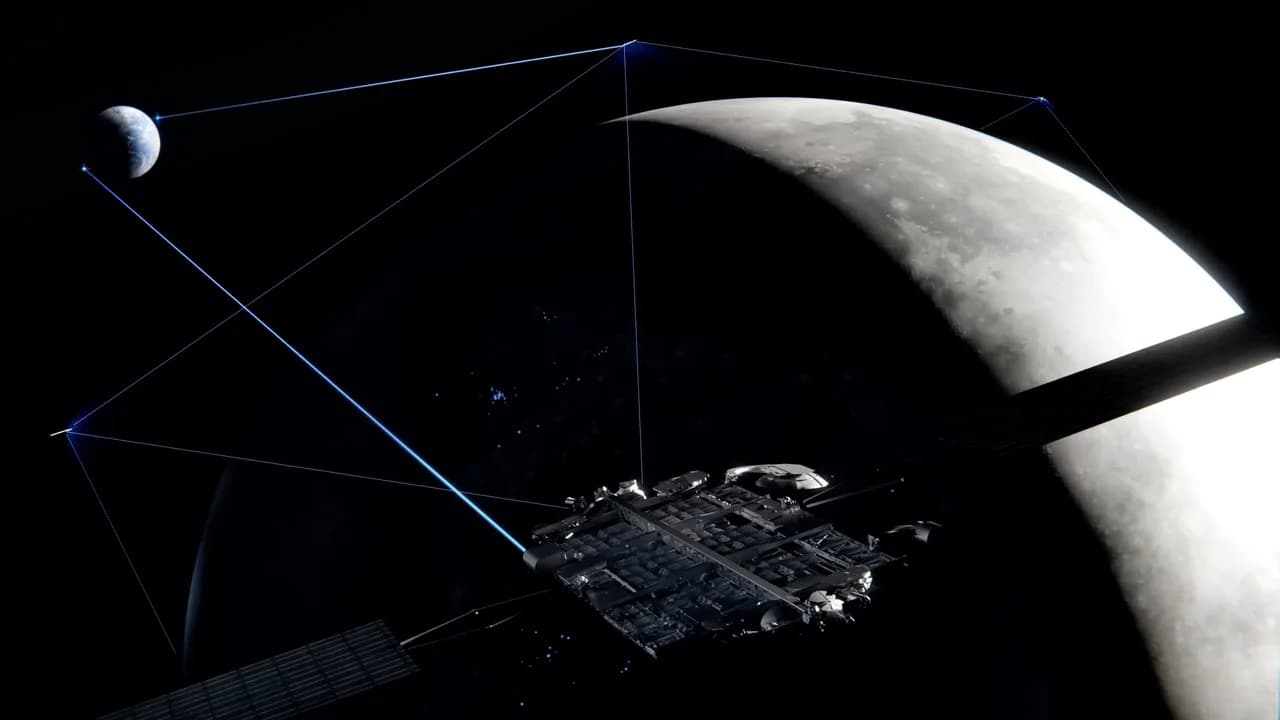
SpaceX has announced plans to establish a Starlink laser communication network around the Moon. The initiative is designed to provide high-speed internet connectivity for future lunar missions. The system will rely on laser links between satellites to achieve gigabit data transfer rates.
The project builds on SpaceX's existing Starlink constellation, which currently provides broadband internet on Earth. For the lunar network, the company will deploy satellites equipped with laser terminals capable of communicating over long distances. These lasers can transmit data at speeds exceeding one gigabit per second.
SpaceX intends to position the satellites in a specific orbit around the Moon to ensure continuous coverage. The network will support communication between lunar bases, rovers, and Earth. This setup eliminates the need for direct line-of-sight connections, which are often interrupted by the Moon's rotation.
The lunar Starlink system is expected to facilitate real-time data transmission for scientific experiments and exploration activities. It will also enable high-definition video streaming from the Moon's surface. The technology could prove critical for NASA's Artemis program, which aims to establish a permanent human presence on the Moon.
SpaceX has not disclosed a specific timeline for the project's completion. However, the company has already tested laser communication on its Starlink satellites in low Earth orbit. Those tests demonstrated stable links between satellites hundreds of kilometers apart.
The lunar network will require additional satellites with enhanced laser systems to handle the greater distances. SpaceX is reportedly developing these specialized satellites at its facilities in Washington state. The company has not announced the total number of satellites planned for the lunar constellation.
SpaceX founder Elon Musk stated that the project represents a significant step toward interplanetary internet. He emphasized that the technology could eventually support missions to Mars. The lunar network is expected to cost several billion dollars, though SpaceX has not provided exact figures.
The Federal Communications Commission has not yet received a license application for the lunar Starlink system. SpaceX will need regulatory approval before deploying satellites around the Moon. The company is expected to file the necessary paperwork in the coming months.
SpaceX's announcement comes as multiple space agencies and private companies prepare for lunar exploration. The network could provide a communication backbone for these missions, reducing reliance on Earth-based ground stations. The first operational phase of the lunar Starlink system is tentatively scheduled for 2025.

Micron opens new DRAM fab in Virginia to ease memory chip shortage
Micron has started production of DRAM chips using its 1-alpha process at its facility in Virginia. The company plans to quadruple DDR4 wafer production capacity with an investment exceeding $2 billion.
Micron announced that it has begun manufacturing DRAM chips using its advanced 1-alpha process node at its facility in Virginia. The move is aimed at addressing the ongoing global memory chip shortage that has affected various industries.
The company is investing more than $2 billion to expand the facility, which will quadruple its DDR4 wafer production capacity. The 1-alpha process is Micron's most advanced DRAM technology, offering improved performance and power efficiency compared to previous generations.
The Virginia facility is one of Micron's key manufacturing sites, and the expansion is expected to create hundreds of new jobs. The increased production will help meet growing demand for memory chips used in data centers, PCs, and other applications.
Micron's 1-alpha DRAM technology was first introduced in early 2021 and has since been deployed across its product lineup. The company claims the new process delivers up to 15% better performance and 20% lower power consumption than its predecessor.
The expansion comes as the semiconductor industry faces supply constraints that have impacted everything from automobiles to consumer electronics. Micron's investment is part of a broader trend of chipmakers increasing production capacity to address the shortage.
The company expects the expanded facility to be fully operational by the end of the year. Micron stated that the new production lines will primarily focus on DDR4 memory, which remains widely used in servers and enterprise systems.
"This investment demonstrates our commitment to meeting customer demand and supporting the global economy," a Micron spokesperson said. The company also noted that the expansion will strengthen the U.S. semiconductor supply chain.

AMD Radeon RX 9070 GRE May Launch Globally After China-Exclusive Debut
AMD's Radeon RX 9070 GRE, initially exclusive to China, is now appearing in global retail listings, suggesting a potential worldwide release. The card features a Navi 48 GPU with 3,840 stream processors and 16GB of GDDR6 memory.

AMD's Radeon RX 9070 GRE graphics card, originally launched as a China-exclusive model, is showing signs of a global rollout. Retail listings for the card have surfaced in multiple regions, indicating that AMD may be preparing to offer the GPU to international customers. The RX 9070 GRE sits between the RX 9070 and RX 9070 XT in AMD's current lineup.
The card is built on the Navi 48 GPU architecture and features 3,840 stream processors. It comes equipped with 16GB of GDDR6 memory on a 256-bit memory bus, delivering a memory bandwidth of 640 GB/s. The GPU operates at a boost clock speed of up to 2.7 GHz, with a total board power rating of 220 watts.
In terms of connectivity, the RX 9070 GRE supports PCIe 5.0 x16 and includes three DisplayPort 2.1 outputs along with one HDMI 2.1 port. The card requires a single 8-pin power connector and has a dual-slot cooler design. These specifications position it as a mid-range offering for 1440p gaming.
Retail listings have been spotted in Europe and other markets, with prices ranging from approximately €550 to €600. In the United States, the card is expected to be priced around $550 to $600, though official pricing has not been confirmed. The listings suggest that third-party manufacturers are preparing custom models for global distribution.
AMD has not made an official announcement regarding the global availability of the RX 9070 GRE. However, the appearance of retail listings indicates that a launch may be imminent. The card is expected to compete with NVIDIA's GeForce RTX 4070 series in the mid-range segment.
The RX 9070 GRE was initially released in China in early 2025 as a response to regional market demands. Its potential global release would provide AMD with a competitive option in the mainstream GPU market. The card supports AMD's FidelityFX Super Resolution and other RDNA 4 features.
Consumers interested in the RX 9070 GRE should monitor major retailers for availability. The card is expected to ship with a standard warranty and driver support from AMD. No official release date has been provided, but listings suggest a launch within the coming weeks.
AMD has not commented on the global expansion of the RX 9070 GRE. The company continues to focus on its RDNA 4 architecture for both desktop and mobile graphics solutions. The RX 9070 GRE's global debut would mark a significant step in AMD's strategy to broaden its GPU portfolio.