Blue Origin's New Glenn rocket explodes during launchpad testing
Blue Origin reported an anomaly that caused the explosion of its New Glenn rocket on the launchpad during testing. The incident occurred at Cape Canaveral Space Force Station.
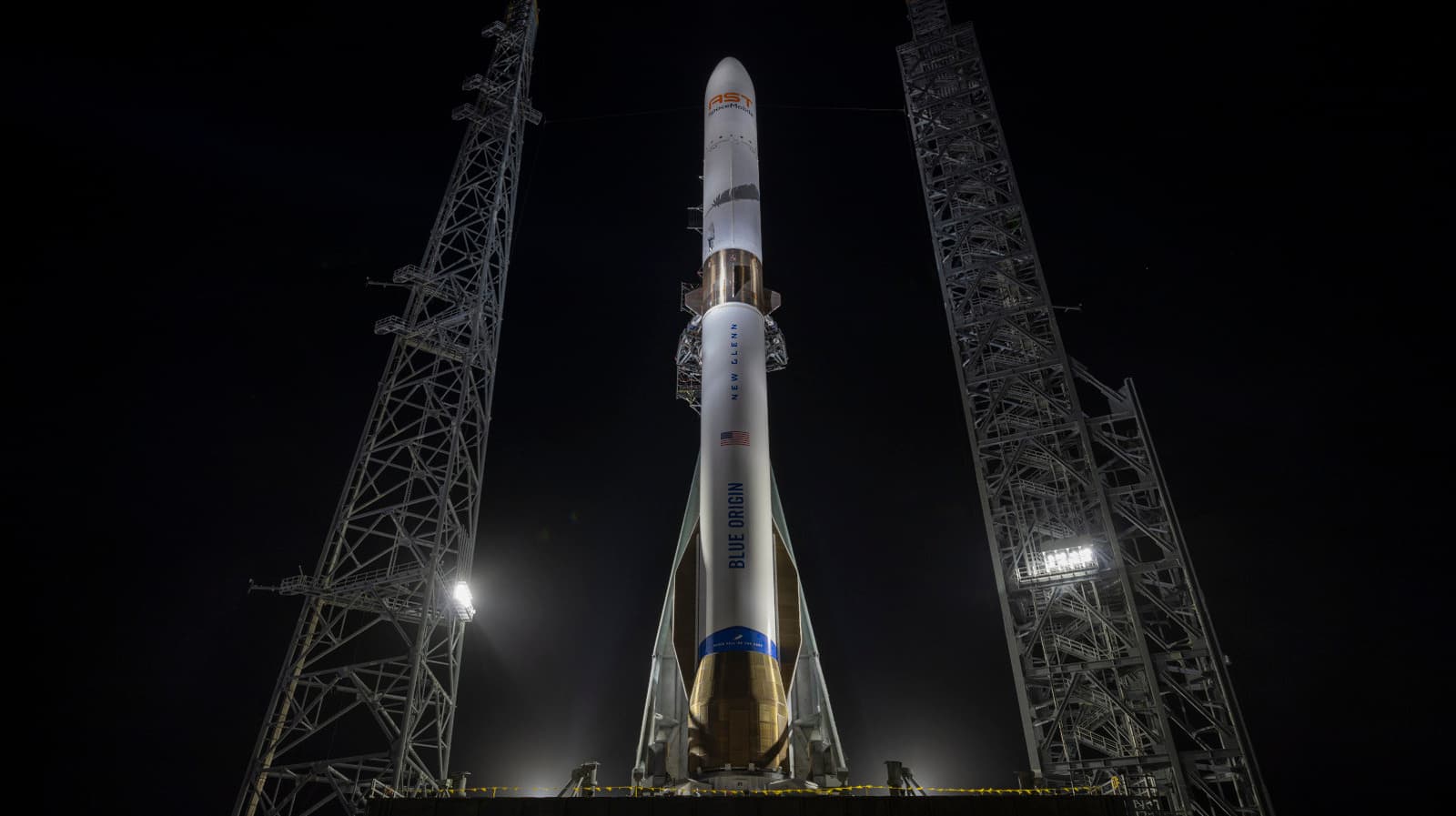
Blue Origin confirmed on Thursday that its New Glenn rocket suffered an explosion during a test at Cape Canaveral Space Force Station. The company described the event as an anomaly that resulted in the loss of the vehicle and damage to the launchpad. No injuries were reported, as the test was conducted without personnel in the immediate vicinity.
The explosion occurred during a propellant loading test, a standard procedure before static fire tests. Blue Origin was preparing the rocket for its maiden flight, which had been scheduled for later this year. The company stated that it is investigating the root cause of the anomaly and will work with regulatory authorities to determine next steps.
New Glenn is a heavy-lift orbital launch vehicle designed to carry payloads to low Earth orbit and beyond. The rocket stands 98 meters tall and is powered by seven BE-4 engines on its first stage. Blue Origin has been developing the rocket for over a decade, with the goal of competing in the commercial launch market alongside SpaceX and United Launch Alliance.
The incident marks a significant setback for Blue Origin, which has faced delays in the New Glenn program. The company had hoped to conduct the rocket's first launch by the end of 2024. The explosion also raises questions about the readiness of the BE-4 engine, which is also used by United Launch Alliance's Vulcan Centaur rocket.
Blue Origin's founder Jeff Bezos expressed disappointment but emphasized the company's commitment to safety and learning from failures. In a statement, the company said it will take the time necessary to understand the anomaly and implement corrective actions. The launchpad, which was built specifically for New Glenn, sustained damage that will require repairs before future launches can proceed.
The Federal Aviation Administration will oversee the investigation, as is standard for launch mishaps. Blue Origin has not provided a timeline for when the investigation will conclude or when the next test might occur. The company's other projects, including the New Shepard suborbital vehicle, are unaffected by the incident.
Blue Origin's New Glenn rocket was intended to compete for national security launches and commercial satellite contracts. The explosion could delay those plans and impact the company's backlog of customers. Blue Origin has not disclosed the financial impact of the incident, but analysts estimate the cost of the rocket alone at hundreds of millions of dollars.
The company said it will provide updates as the investigation progresses. Blue Origin remains committed to its mission of enabling a future where millions of people live and work in space, the statement read. The explosion occurred on September 12, 2024, at Cape Canaveral Space Force Station in Florida.
Elon Musk Contradicts Official Documents on Anthropic Data Center Lease
Elon Musk made statements about the duration of SpaceX's lease of the Colossus data center to Anthropic that contradict official documents. The discrepancy raises questions about the terms of the agreement between the two companies.

Elon Musk has publicly contradicted official documents regarding the lease of SpaceX's Colossus data center to Anthropic. The billionaire entrepreneur made statements about the lease duration that differ from what is recorded in official filings. The Colossus data center, owned by SpaceX, was leased to Anthropic, an artificial intelligence company. Musk's comments have created confusion about the actual terms of the agreement. The discrepancy between Musk's statements and the official documents has not been explained by either party. Anthropic has not commented on the matter. The lease of the Colossus data center is part of a broader partnership between SpaceX and Anthropic. The data center is used to support Anthropic's AI research and development. Musk's remarks were made during a public appearance, but he did not provide details on why his account differs from the documents. The official documents suggest a different timeline for the lease than what Musk described. It remains unclear which version is accurate. The situation highlights ongoing tensions between Musk's public statements and formal business records. SpaceX and Anthropic have not issued a joint statement to clarify the issue. The Colossus data center is one of the largest facilities of its kind, and its lease is a significant business deal. Musk's involvement with Anthropic has been a subject of interest given his own AI ventures. The contradiction may lead to further scrutiny of the agreement by regulators or investors. For now, the exact terms of the lease remain ambiguous.

Asana Acquires No-Code Agent-Builder StackAI for AI Workflow Tools
Asana has acquired StackAI, a no-code platform for building AI agents. The company plans to integrate StackAI's technology into its AI workflow tools.
Asana announced the acquisition of StackAI, a startup that provides a no-code platform for building AI agents. The deal was disclosed on Tuesday, though financial terms were not revealed.
StackAI's platform allows users to create AI agents without writing code, enabling automation of complex tasks. The technology will be folded into Asana's existing suite of AI-powered workflow tools.
Asana has been expanding its AI capabilities over the past year. The company launched Asana Intelligence in 2023, which includes features like smart suggestions and automated task assignments.
The acquisition of StackAI is expected to accelerate Asana's development of more sophisticated AI agents. These agents could handle multi-step workflows and integrate with other business applications.
Asana CEO Dustin Moskovitz said in a statement that the acquisition will help the company deliver on its vision of an AI-powered work management platform. He noted that StackAI's team will join Asana.
StackAI was founded in 2022 and had raised $2.5 million in seed funding. Its platform was used by companies to build custom AI assistants for customer support, data analysis, and other tasks.
The deal is expected to close in the coming weeks, subject to customary closing conditions. Asana did not provide a specific timeline for when StackAI's features would be integrated into its products.
Asana shares rose slightly in after-hours trading following the announcement. The company reported $171.5 million in revenue in its most recent quarter, up 14% year-over-year.

Researchers Achieve First-Ever Perfect Random Number Generation Using Quantum Physics
Scientists at ETH Zurich have developed a method to generate flawless random numbers using quantum physics. This breakthrough could have significant implications for cryptography and secure communications.

Researchers at the Swiss Federal Institute of Technology Zurich (ETH Zurich) announced they have successfully generated what they describe as "perfect" random numbers for the first time. The team leveraged principles of quantum physics to create a system that produces truly unpredictable sequences, overcoming limitations of classical random number generators.
Classical random number generators rely on deterministic algorithms or physical processes that can be predicted or replicated under certain conditions. In contrast, the quantum method exploits the inherent randomness of quantum measurements, such as the behavior of photons, to produce numbers that are fundamentally unpredictable.
The ETH Zurich team designed an experimental setup where laser pulses are split and their quantum states measured. The outcomes of these measurements are inherently random, as dictated by the laws of quantum mechanics. By carefully controlling the experiment and eliminating sources of bias, the researchers achieved a level of randomness that meets rigorous mathematical standards.
To verify the quality of the randomness, the scientists applied a battery of statistical tests. The generated numbers passed all tests for unpredictability and lack of pattern, confirming their status as "perfect" random numbers. This marks a milestone in the field of quantum random number generation.
The implications of this achievement are far-reaching. Secure encryption systems rely on random numbers for generating keys; if those numbers are predictable, the security can be compromised. Perfect random numbers could bolster cybersecurity, protect financial transactions, and enhance privacy in digital communications.
Beyond cryptography, the technology could benefit scientific simulations that require high-quality randomness, such as in Monte Carlo methods used in physics and finance. It may also advance quantum computing and quantum communication systems, where randomness is a critical resource.
The research was published in the journal Physical Review Letters. The team emphasized that while the current setup is laboratory-based, it demonstrates the feasibility of generating perfect randomness on demand. Further work is needed to miniaturize and speed up the process for practical applications.
ETH Zurich plans to continue refining the technique, aiming to increase the generation rate and integrate it into compact devices. The researchers noted that commercial quantum random number generators already exist, but none have achieved the level of perfection demonstrated in this study.
"This is a fundamental step forward," said a lead researcher. "We have shown that perfect randomness is not just a theoretical concept but can be realized in practice." The team expects that their method will pave the way for next-generation security systems built on unbreakable cryptographic protocols.

Cloud Providers Retool Infrastructure for AI-Driven Machine Traffic Surge
AWS, Cloudflare, and other cloud providers are redesigning their infrastructure to handle a future where the majority of internet traffic comes from AI agents rather than human users. This shift involves optimizing for machine-to-machine communication patterns and higher request volumes.

Major cloud infrastructure companies are rethinking their network architectures as artificial intelligence agents begin to generate a significant share of internet traffic. AWS and Cloudflare, among others, have announced updates to their platforms aimed at accommodating the unique demands of machine-driven data flows. The changes reflect a broader industry recognition that the internet is being rebuilt for automated systems rather than human browsing.
Cloudflare recently introduced a new service called AI Gateway, designed to manage and optimize traffic from AI applications. The service provides caching, rate limiting, and analytics specifically for requests made by AI models and agents. AWS, meanwhile, has been updating its networking stack to reduce latency for machine-to-machine communications, which often require rapid, high-frequency interactions.
The shift is driven by the growing deployment of AI agents in production environments. These agents, which can perform tasks like customer service, data analysis, and content generation, generate traffic patterns that differ from human users. They tend to make more frequent, smaller requests and require consistent, low-latency responses. Traditional cloud infrastructure, optimized for human web browsing, is not always suited to these patterns.
Cloud providers are also focusing on security implications. Machine-generated traffic can be harder to distinguish from malicious bots, leading to new challenges in fraud detection and access control. Cloudflare has introduced bot management features that can differentiate between benign AI agents and harmful automated scripts. AWS offers similar capabilities through its WAF and Shield services.
Another area of investment is edge computing. By processing AI agent requests closer to the user or device, providers can reduce latency and bandwidth costs. Cloudflare's Workers platform allows developers to run code at the edge, enabling real-time responses for AI agents. AWS's Lambda@Edge provides similar functionality.
The redesign extends to pricing models as well. Some providers are introducing usage-based pricing that accounts for the high volume of small requests typical of AI agents. This contrasts with traditional models that charge per gigabyte of data transferred, which may not reflect the actual cost of processing many small transactions.
Industry analysts note that this transformation is still in its early stages. Most internet traffic today remains human-generated, but the proportion of machine traffic is expected to grow rapidly as AI adoption increases. Cloud providers are positioning themselves to capture this emerging market by offering specialized tools and infrastructure.
AWS and Cloudflare have both emphasized that their updates are backward-compatible, ensuring that existing human-centric applications continue to function. However, the long-term trend points toward a bifurcated internet where infrastructure is optimized for both human and machine users. The companies are investing heavily in research to anticipate future traffic patterns.
"The internet is being rebuilt for machines," said a Cloudflare executive in a statement. The company plans to roll out additional AI-specific features over the next year. AWS has not made a similar public statement but has been quietly updating its networking documentation to include best practices for AI agent workloads.