Marshall Revives ANC in Smaller On-Ear Headphones with Milton A.N.C.
Marshall has launched the Milton A.N.C., its first on-ear headphones with active noise canceling since the 2018 Mid A.N.C. model. Priced at $229.99, they are available now on Marshall's website and will reach other retailers on May 27th.

Marshall has introduced the Milton A.N.C., a new pair of on-ear wireless headphones that bring active noise cancelation back to the company's smaller form factor. The last Marshall headphones to feature ANC in this category were the Marshall Mid A.N.C., which debuted in 2018. Since then, noise canceling has been exclusive to the larger over-ear Monitor III A.N.C. model.
The Milton A.N.C. retains Marshall's signature design language, including a textured leather finish and gold accents. The headphones are designed to be lightweight and portable, catering to users who prefer a compact on-ear style without sacrificing noise cancelation. Marshall has not disclosed specific battery life figures for the Milton A.N.C., but the company emphasizes that ANC is now available in a more travel-friendly package.
Priced at $229.99, the Milton A.N.C. sits $70 above the Marshall Major V, another on-ear model that lacks ANC but offers over 100 hours of playback. The price difference reflects the addition of active noise cancelation and potentially other features, though Marshall has not detailed further specifications. The Major V remains a budget-friendly alternative for those who prioritize battery life over noise isolation.
The headphones are available for purchase starting today through Marshall's official online store. Broader availability will follow on May 27th, when the Milton A.N.C. will be sold at select retailers. Marshall has not specified which retailers will carry the product, but the company typically partners with major electronics and audio stores.
Marshall's decision to reintroduce ANC in its on-ear lineup suggests a response to consumer demand for noise cancelation in smaller headphones. The Milton A.N.C. competes with other compact ANC models from brands like Sony and Bose, though Marshall differentiates itself with its vintage-inspired aesthetic. The company has not announced plans for additional colors or variants.
For now, the Milton A.N.C. is available only in black, consistent with Marshall's classic look. The headphones come with a carrying case, charging cable, and audio cable for wired use. Marshall's website lists the product as in stock with standard shipping options.
As of the launch date, the Milton A.N.C. is priced at $229.99 and available exclusively on Marshall's website. Retail partners will begin selling the headphones on May 27th.
Microsoft refreshes Surface Pro and Laptop with Intel Core Ultra chips
Microsoft launched the Surface Pro 12 and Surface Laptop 8 with Intel Core Ultra Series 3 processors, starting at $1,949.99 for the business-focused Surface Pro. The Intel models arrive ahead of Qualcomm Snapdragon X2 versions expected later this year.
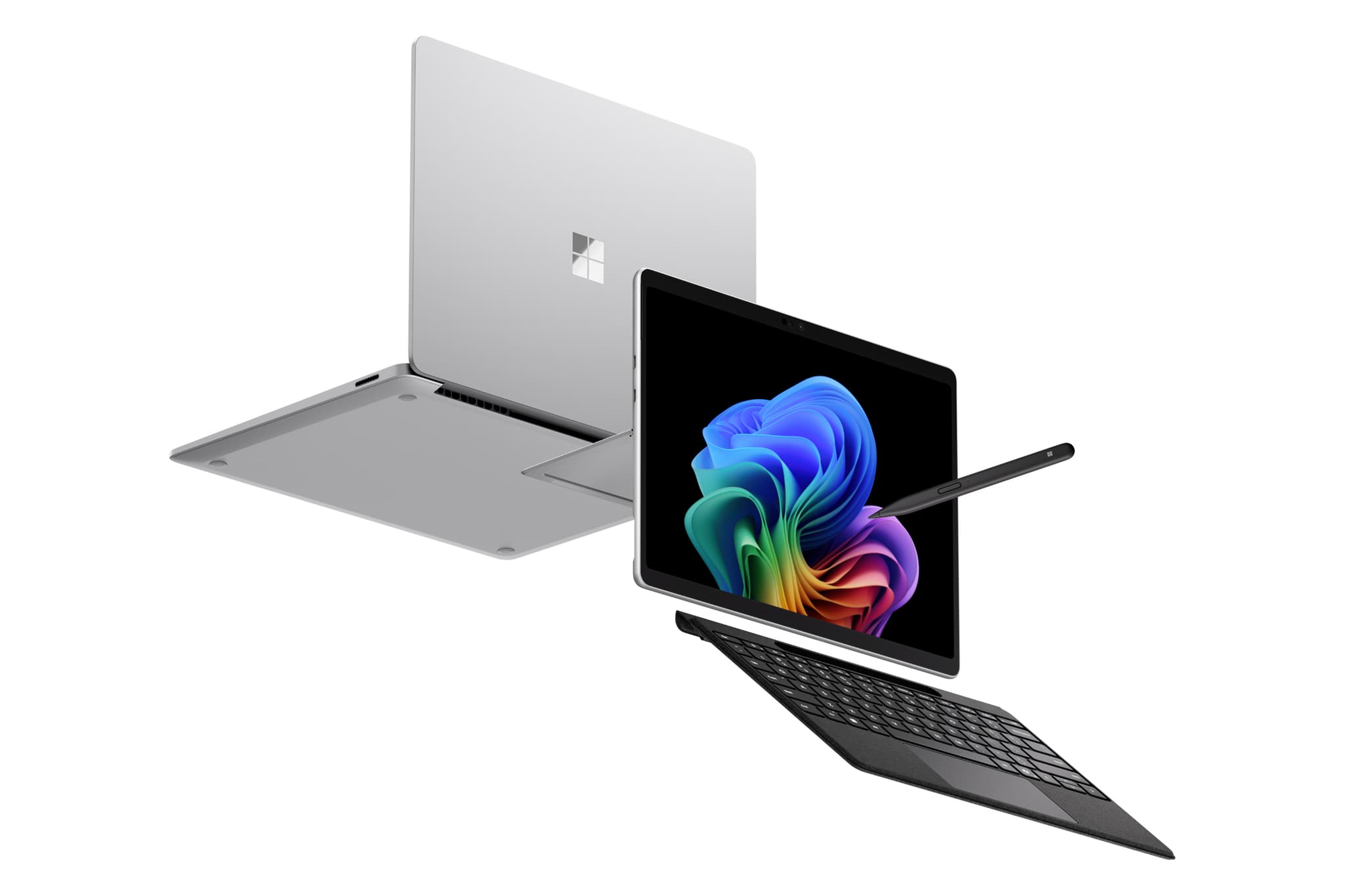
Microsoft has introduced new versions of its Surface Pro and Surface Laptop lines, this time powered by Intel's latest Core Ultra Series 3 processors. The company is prioritizing Intel chips for this refresh cycle, a shift from its previous strategy where Arm-based models debuted first. The Surface Pro 12, officially named the Surface Pro for Business 13-inch (12th Edition), is available for business customers starting today. Its base configuration includes an Intel Core Ultra 5 processor and carries a price tag of $1,949.99. The Surface Laptop 8 also receives the Intel Core Ultra Series 3 update, though Microsoft has not disclosed specific pricing or availability details for that model at launch.
The decision to lead with Intel chips marks a departure from the timeline of the previous generation. In 2023, Microsoft unveiled Arm-based Surface Pro 11 and Surface Laptop 7 models nearly two years ago, with Intel variants arriving more than six months later. This time, the Intel versions are arriving first, with Qualcomm's Snapdragon X2-powered models expected to follow later in the year. The Core Ultra Series 3 processors are designed to deliver improved performance and efficiency, particularly for AI workloads, leveraging Intel's integrated neural processing unit.
The Surface Pro 12 targets business users with its 13-inch display and detachable design, offering a versatile form factor for productivity. The base model includes 16GB of RAM and a 256GB SSD, with options to upgrade to higher memory and storage configurations. Microsoft has not yet announced consumer versions of the Surface Pro 12 or Surface Laptop 8, suggesting the initial focus is on enterprise and commercial customers. The devices run Windows 11 and include features such as Windows Hello facial recognition and a 1080p front-facing camera.
Microsoft's decision to prioritize Intel chips may reflect a desire to cater to business customers who require compatibility with legacy software and peripherals. Arm-based systems, while offering longer battery life and cellular connectivity, can face compatibility challenges with certain x86 applications. By launching Intel models first, Microsoft ensures that the Surface Pro 12 and Surface Laptop 8 can run the full range of Windows software without emulation.
The Surface Laptop 8, meanwhile, retains the traditional clamshell design with a 15-inch or 13.5-inch display option, depending on the configuration. It features a precision touchpad and a full-size keyboard, appealing to users who prefer a laptop form factor. Both devices support Thunderbolt 4 via USB-C ports, enabling fast data transfer and external display connectivity.
Pricing for the Surface Laptop 8 has not been officially confirmed, but it is expected to start at a similar premium to the Surface Pro 12. Microsoft has not provided a specific release date for the consumer versions, though they are likely to follow in the coming months. The company is also expected to offer configurations with Intel Core Ultra 7 processors and up to 32GB of RAM for higher-end workloads.
The Surface Pro 12 and Surface Laptop 8 are available for order through Microsoft's business store and authorized resellers. The base Surface Pro 12 model is priced at $1,949.99, with higher-tier configurations reaching over $2,500. Microsoft has not announced any trade-in or discount programs for these devices at launch.

Federal court rejects Musk's claims against OpenAI, saying he filed his lawsuit too late
A federal court dismissed Elon Musk's claims against OpenAI and its executives, ruling that he filed his lawsuit too late. The court found that Musk waited too long to bring his case alleging betrayal of a shared nonprofit vision.

A federal court on Monday dismissed claims filed against OpenAI and its top executives by Elon Musk, who accused them of betraying a shared vision for it to remain a nonprofit dedicated to guiding artificial intelligence’s development for the good of humanity. The nine-person jury found Musk waited too long to bring his lawsuit, ruling that the statute of limitations had expired. The decision effectively ends Musk's legal challenge against the AI company he co-founded in 2015 but left in 2018.
Musk had alleged that OpenAI, along with CEO Sam Altman and president Greg Brockman, abandoned the original mission of developing AI for public benefit in favor of profit. He claimed the company's shift to a for-profit structure and its partnership with Microsoft violated the founding agreement. The court, however, determined that Musk's claims were time-barred, as the alleged breaches occurred years ago.
The lawsuit, filed in February 2024, sought to force OpenAI to return to its nonprofit roots and prevent it from using its technology for commercial gain. Musk argued that OpenAI's collaboration with Microsoft, which invested billions, represented a fundamental departure from the nonprofit ethos. The court's ruling did not address the merits of those allegations but focused solely on the timing of the filing.
OpenAI's legal team welcomed the decision, stating that the court recognized the lawsuit as an attempt to re-litigate old grievances. They emphasized that the company has always operated within the law and continues to prioritize safety and ethical AI development. Musk's attorneys indicated they may appeal the ruling, though no formal notice has been filed.
The case highlights ongoing tensions in the AI industry over the balance between open research and commercial interests. Musk, who now runs his own AI startup xAI, has been a vocal critic of OpenAI's direction. The court's dismissal does not preclude future legal actions but sets a precedent regarding the timeliness of such claims.
OpenAI remains focused on its mission to ensure that artificial general intelligence benefits all of humanity, according to a company spokesperson. The ruling allows the company to proceed without the distraction of litigation, though public scrutiny of its governance structure persists. The jury's decision was unanimous, and the judge entered judgment in favor of the defendants.
Musk's lawsuit had drawn attention to the evolving nature of AI organizations, many of which have transitioned from nonprofit to for-profit models. The court's emphasis on procedural timing rather than substantive issues leaves the broader debate unresolved. For now, OpenAI continues its operations, including the development of advanced AI models like GPT-4, under its current corporate structure.

GSI Technology Wins Phase I of Smart City Project in Taiwan, First Gemini-II APU Deployment
GSI Technology has been awarded Phase I of a Smart City project by the Hsinchu County government in Taiwan. The completion of Phase I will mark the company's first smart city deployment of the Gemini-II APU.

GSI Technology, Inc., the developer of the Associative Processing Unit (APU), announced it has secured Phase I of a Smart City project from the Hsinchu County government in Taiwan. The project represents the company's initial foray into smart city applications for its Gemini-II APU. GSI Technology, based in Sunnyvale, California, trades on the Nasdaq under the ticker GSIT.
The Gemini-II APU is built on GSI Technology's compute-in-memory architecture, which the company describes as a paradigm shift in artificial intelligence and high-performance computing. The APU is designed to perform AI inference and other compute-intensive tasks directly within memory, reducing data movement and improving energy efficiency.
Phase I of the project will involve deploying the Gemini-II APU for specific smart city applications, though GSI Technology did not disclose the exact use cases or the financial terms of the award. The company stated that the completion of Phase I will mark its first commercial smart city deployment of the Gemini-II chip.
GSI Technology has been working to commercialize its APU technology across various sectors, including AI, edge computing, and data centers. The smart city project in Taiwan is a significant step toward broader adoption of its compute-in-memory solutions.
The Hsinchu County government selected GSI Technology for the project after evaluating the company's technology and its potential to address smart city challenges. The collaboration aims to leverage the Gemini-II APU's capabilities to enhance urban infrastructure and services.
GSI Technology expects Phase I to be completed within a specified timeframe, though the company did not provide a specific deadline. The project's success could pave the way for additional phases and further deployments in other smart city initiatives.
"We are honored to be awarded Phase I of this Smart City project by the Hsinchu County government," said a GSI Technology spokesperson in the official announcement. "This deployment will demonstrate the real-world benefits of our Gemini-II APU in a smart city environment."

Solar to Dominate Energy by 2035, but AI Data Centers Will Keep Fossil Fuels in Business
Solar energy is projected to become the dominant power source by 2035, with costs dropping 30% in the next decade. However, rising energy demand from AI data centers will sustain fossil fuel usage.

Solar power is on track to become the world's leading energy source by 2035, according to a new report. The cost of solar panels is expected to fall by an additional 30% over the next ten years, accelerating adoption. This price decline will make solar the cheapest form of electricity in most regions, outpacing coal and natural gas.
Despite solar's rapid growth, the report warns that fossil fuels will not disappear. The surge in energy consumption from artificial intelligence data centers is creating a persistent demand for reliable power. These facilities require constant electricity, which solar alone cannot provide due to its intermittent nature.
Natural gas and coal plants are being kept online to back up renewable grids. In the United States, utilities are delaying retirements of fossil fuel plants to meet AI-driven demand. Tech companies like Google and Microsoft are investing in renewable energy but also signing contracts for gas-fired power.
The International Energy Agency projects that global electricity demand from data centers could double by 2026. This growth is straining grids and slowing the transition away from fossil fuels. Solar will supply a growing share, but gas and coal will remain essential for baseline power.
Solar's cost decline is driven by manufacturing scale and efficiency improvements. China dominates production, with factories operating at record capacity. This oversupply has pushed panel prices down, making solar projects more economical even without subsidies.
By 2035, solar could account for over 30% of global electricity generation, up from about 5% today. However, without breakthroughs in battery storage, solar's variability limits its ability to replace fossil fuels entirely. AI data centers, which run 24/7, exacerbate this challenge.
The report concludes that while solar will lead in capacity additions, fossil fuels will retain a role for decades. The interplay between clean energy growth and AI's insatiable power needs will define the future energy mix. Policymakers face pressure to accelerate storage deployment and grid modernization.
Solar's dominance is assured, but the pace of fossil fuel phase-out remains uncertain. The data center boom ensures that natural gas and coal will continue to generate significant electricity through 2035 and beyond.