Nvidia earnings report to test AI chip dominance amid shifting market
Nvidia is set to report earnings on Wednesday, with expectations high for another strong quarter. However, changes in AI usage patterns are raising questions about the sustainability of its chip market leadership.
Nvidia will release its quarterly earnings report on Wednesday, and analysts anticipate another robust performance. The company has been a dominant force in the AI chip market, but evolving trends in artificial intelligence deployment are prompting scrutiny of its long-term position.
The shift toward inference-based AI workloads, which require different processing capabilities than training models, could alter demand dynamics. While Nvidia's GPUs have been essential for training large AI models, competitors are developing specialized chips for inference tasks.
Nvidia's data center revenue has surged over the past year, driven by demand from cloud providers and enterprises building AI infrastructure. The company's upcoming earnings will provide insight into whether this growth trajectory can be maintained.
Investors will focus on Nvidia's guidance for the current quarter, as well as any commentary on supply chain constraints and customer adoption patterns. The company has faced challenges in meeting demand for its high-end chips, including the H100 and upcoming Blackwell architecture.
Some analysts have expressed concerns about potential market saturation as AI model training becomes more efficient. Others point to the expansion of AI into new sectors, such as healthcare and automotive, as a source of continued demand.
Nvidia's stock has more than tripled over the past year, reflecting optimism about its AI prospects. However, the company faces increasing competition from AMD, Intel, and custom chip designs from major cloud providers.
The earnings report will be closely watched for signs of how Nvidia plans to navigate these competitive pressures. The company has been investing in software and networking technologies to create a more comprehensive AI platform.
Nvidia's CEO Jensen Huang has emphasized the company's role in enabling the next wave of AI innovation. The earnings call on Wednesday will offer a concrete update on whether that vision is translating into sustained financial performance.
YouTube launches AI-powered conversational search and Gemini Omni for Shorts
YouTube introduces 'Ask YouTube', an AI-powered conversational search feature, and integrates Gemini Omni into Shorts. The updates aim to enhance user interaction and content discovery on the platform.

Google has announced a significant overhaul of its search capabilities on YouTube, introducing a new feature called 'Ask YouTube' that leverages artificial intelligence to enable conversational search. The update allows users to ask questions in natural language and receive relevant video results, moving beyond traditional keyword-based queries. Additionally, YouTube is integrating Gemini Omni into its Shorts format, bringing advanced AI capabilities to short-form video content.
The 'Ask YouTube' feature is designed to understand complex queries and provide direct answers from video content. For instance, users can ask questions like 'How do I fix a leaky faucet?' and the AI will surface specific segments from instructional videos. This functionality relies on Google's large language models and video understanding technology, which can parse spoken words, on-screen text, and visual elements within videos.
Gemini Omni, Google's multimodal AI model, is being integrated into YouTube Shorts to enhance content creation and discovery. Creators can use the AI to generate captions, suggest edits, or even create short clips from longer videos. The model can also analyze viewer preferences to recommend personalized Shorts feeds, improving user engagement.
These updates come as part of Google's broader strategy to infuse AI across its products. The company has been testing conversational search features in its main search engine and is now extending similar capabilities to YouTube. The move aims to make video content more accessible and interactive, particularly for users seeking specific information or tutorials.
YouTube's AI-powered search is expected to roll out gradually to users in the coming weeks, starting with English-language queries. The feature will be available on both mobile and desktop versions of the platform. Google has not specified a timeline for global availability but confirmed that additional languages will be supported in the future.
For creators, Gemini Omni integration in Shorts will be available through YouTube Studio. The tool offers features like automatic captioning, scene detection, and music suggestions. Google emphasized that the AI is designed to assist creators without replacing their creative input, maintaining the authenticity of user-generated content.
Privacy considerations have been addressed, with Google stating that user data from conversational searches will be handled according to its existing privacy policies. The company also noted that AI-generated suggestions in Shorts will be clearly labeled to maintain transparency.
YouTube's parent company, Google, announced these features during its recent product update event. The company highlighted that the AI enhancements are part of ongoing efforts to improve user experience and content discoverability on the platform. 'Ask YouTube' and Gemini Omni for Shorts are now rolling out to select users, with broader availability expected later this year.

Google launches Universal Cart to track shopping across devices and retailers
Google announced Universal Cart, a new feature that tracks users' shopping across multiple devices and retailers. The tool aims to simplify the online shopping experience by consolidating cart items from various sites.
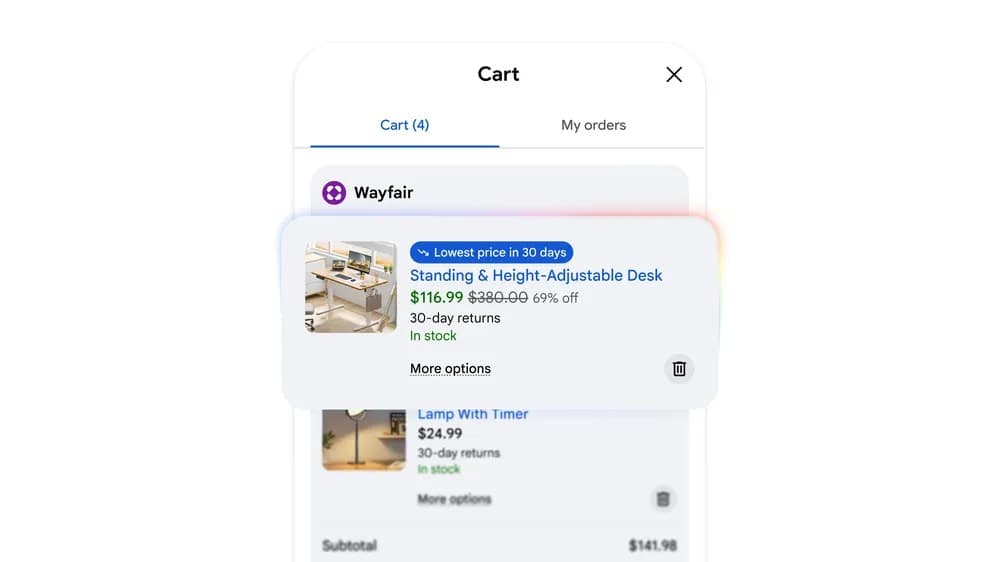
Google introduced Universal Cart, a feature designed to follow users' shopping journeys across different devices and online retailers. The announcement was made during the company's annual developer conference. Universal Cart aims to address the fragmented nature of online shopping, where consumers often browse and add items to carts on multiple sites over several days.
The feature integrates with Google's Shopping platform and uses the user's Google account to sync cart data across devices. When a user adds an item to their cart on a participating retailer's site, Universal Cart saves that information. The user can then access their cart from any device, including smartphones, tablets, and desktop computers.
Universal Cart also provides price tracking and alerts. If the price of an item in the cart drops, Google will notify the user. The feature can also suggest alternative products or retailers based on the user's shopping history and preferences. Google emphasized that user privacy is a priority, and the data is encrypted and not shared with third parties without consent.
Retailers that have signed up for Universal Cart include major brands like Target, Walmart, and Best Buy. Google plans to expand the list of participating retailers over time. The feature is currently rolling out in the United States, with a global expansion expected later this year.
To use Universal Cart, users need a Google account and must enable the feature in their Google Shopping settings. The feature is available on the Google Shopping app and website. Google stated that Universal Cart is free for both users and retailers, with no additional fees for participation.
The launch of Universal Cart comes as Google faces increasing competition from Amazon in the online shopping space. Amazon offers a similar feature called Amazon Cart, which syncs across devices but is limited to Amazon's own platform. Google's Universal Cart aims to provide a cross-retailer solution.
Google also announced that Universal Cart will integrate with its Google Assistant, allowing users to add items to their cart via voice commands. The feature will be available on Google Home devices and Android smartphones. Google plans to add support for iOS devices in the coming months.
Universal Cart is now available to all users in the U.S. who have the latest version of the Google Shopping app. Google encourages users to provide feedback to help improve the feature. The company has not announced a specific date for the international rollout but expects it to begin in the fourth quarter of this year.

Mach Industries Acquires Defense Tech Firm for $50M to Boost Unit Economics
Mach Industries has acquired a defense technology company for $50 million to improve unit economics across its vehicle programs. The deal comes as the company begins scaling production.

Mach Industries announced it has completed a $50 million acquisition of an undisclosed defense technology company. The purchase is aimed at addressing a major challenge in the defense tech sector: improving the cost efficiency of manufacturing advanced systems at scale.
The acquisition will meaningfully improve unit economics across Mach's five vehicle programs, the company said. These programs include unmanned aerial systems and other defense platforms that the company has been developing for military customers.
Mach Industries has been working to transition from prototype development to volume production. The company's leadership stated that the acquired technology and expertise will help reduce per-unit costs while maintaining performance standards.
The deal comes at a time when defense tech startups are under pressure to deliver affordable solutions to the Pentagon and allied militaries. Many companies in the sector struggle with high production costs that limit the number of units they can field.
Mach's five vehicle programs cover a range of mission types, including reconnaissance, logistics, and strike capabilities. The company has not disclosed which specific programs will benefit most from the acquisition.
Financial terms of the deal were confirmed at $50 million. The acquisition includes intellectual property, manufacturing equipment, and a team of engineers who will join Mach's workforce.
Mach Industries expects the integration to be completed within the next quarter. The company plans to begin incorporating the acquired technology into its production lines immediately.
The acquisition was funded through a combination of cash and equity. Mach's investors include prominent venture capital firms focused on defense technology.
"This acquisition strengthens our ability to deliver affordable, high-performance systems to our customers," a Mach spokesperson said in a statement. The company declined to provide further details about the acquired firm's identity or specific technologies involved.

The Vergecast dissects Google I/O 2026: agents, Spark, and the singularity
The Vergecast analyzed Google I/O 2026 highlights, including a conversational Gmail bot and DeepMind's singularity claim. Senior AI Reporter Hayden Field joined to discuss Google's new agent-focused services like Spark and Antigravity upgrades.

The Vergecast went live immediately after Google I/O 2026's two-hour keynote, offering a deep dive into the event's most notable announcements. Senior AI Reporter Hayden Field joined the show to break down the key moments, from a Gmail bot capable of natural conversation to DeepMind's leader declaring the singularity is near.
Agents emerged as the central theme of the keynote, positioning them as Google's latest strategy for making AI practical. The company introduced Spark, a service that bears resemblance to a Gemini-infused version of OpenClaw, alongside enhancements to its Antigravity platform. A suite of agents designed to handle shopping and track search topics was also unveiled.
The discussion also touched on the broader implications of these developments, including how Google's agent-based approach could reshape user interactions with AI. The Vergecast panel examined the potential impact of these tools on daily tasks and productivity.
DeepMind's singularity comment sparked particular interest, with the panel weighing its significance in the context of Google's AI trajectory. The conversation highlighted the tension between ambitious long-term goals and immediate product releases.
Google's focus on agents reflects a shift toward more autonomous AI systems that can perform complex tasks on behalf of users. The new services aim to integrate AI more deeply into everyday workflows, from email management to online shopping.
The Vergecast also explored how Spark compares to existing AI tools, noting its potential to compete with other platforms in the space. The Antigravity upgrades were described as a significant step forward for Google's cloud AI offerings.
Full coverage of Google I/O 2026 is available on The Verge, including detailed breakdowns of each announcement and analysis of their market implications.