Airbnb Host Sues Robotics Startup Over Alleged Property Damage During Robot Testing
A San Francisco robotics startup is being sued by an Airbnb host who claims the company's robotic prototype testing caused extensive damage to his home. The lawsuit seeks more than $12,000 in damages.

A San Francisco robotics startup is facing a lawsuit from an Airbnb host who alleges the company's robotic prototype testing caused extensive damage to his property. The complaint was filed on May 26, 2026, by Sean Donovan, who is seeking over $12,000 in damages from The Bot Company, a Bay Area startup. The case was first reported by SFGate, which also interviewed Donovan about the unusual mess he discovered after the startup's employees rented his former childhood home through Airbnb.
Donovan first suspected something was amiss when he was handling trash during the guests' stay. He told SFGate about finding "bundles of wires" scattered throughout the house and a robot that he described as a 6-foot-tall "Roomba with treads," which he likened to the cybernetic Borg from Star Trek. The robot, according to Donovan, appeared to be a prototype being tested by the startup's employees.
The lawsuit alleges that the testing activities caused significant damage to the property, including marks on walls and floors, as well as potential structural issues. Donovan claims that the startup's employees did not disclose their intention to use the home for robot testing when booking the Airbnb. The Bot Company has not yet publicly responded to the allegations.
This incident raises questions about the responsibilities of companies using short-term rentals for unconventional purposes. Airbnb's terms of service generally prohibit commercial activities without prior approval, and hosts can seek damages for violations. The case could set a precedent for how such disputes are handled in the future.
The Bot Company, which focuses on developing autonomous robots for household tasks, has not commented on the lawsuit. The company's website describes its mission to create robots that can navigate complex indoor environments. It remains unclear whether the prototype involved in the incident was part of a commercial product or an experimental model.
Donovan is seeking compensation for repairs, cleaning, and loss of rental income. The lawsuit also requests that the startup cover legal fees. The case is currently pending in San Francisco Superior Court, with no trial date set yet.
As of now, The Bot Company has not filed a response to the lawsuit. The outcome of this case may influence how robotics startups approach testing in real-world environments, particularly when using shared accommodations.
Apple Music Beta Code Hints at Ad-Supported Free Tier
Apple Music may soon offer a free, ad-supported subscription tier. Code found in the beta version of the app suggests the company is developing such a plan.

Apple Music could be preparing to introduce a free, ad-supported subscription tier, according to code discovered in the app's beta version. The finding suggests the company is exploring a model similar to Spotify's free offering, which includes advertisements between songs.
The code snippets, spotted by developers analyzing the beta build, reference terms like "ad-supported" and "free tier." While the feature is not yet active, its presence in the code indicates Apple is actively working on the option. The company has not officially announced any plans to launch a free version of its music streaming service.
Currently, Apple Music offers a three-month free trial for new users, after which a paid subscription is required. The service costs $10.99 per month for individuals, $16.99 for families, and $5.99 for students. A free, ad-supported tier would mark a significant shift in Apple's strategy, which has historically focused on paid subscriptions.
Spotify, Apple Music's main competitor, has long offered a free tier with ads, which has helped it amass a larger user base. Spotify's free version includes limitations such as shuffle-only playback on mobile and the inability to skip tracks freely. Apple's potential free tier could follow a similar model to attract price-sensitive users.
The code discovery comes as Apple Music continues to grow its subscriber base, though it still trails Spotify globally. Introducing a free tier could help Apple compete more aggressively in markets where paid subscriptions are less common. However, it remains unclear when or if Apple will roll out the feature.
Apple has not commented on the code findings. The beta version is typically used for testing new features before a public release. If Apple proceeds with the ad-supported tier, it would need to balance user experience with revenue from advertising.
The move could also impact Apple's relationships with record labels, as free tiers often involve different licensing agreements. Apple would need to negotiate terms that allow ad-supported streaming while ensuring fair compensation for artists.
For now, the code remains a hint of what might come. Apple Music users will have to wait for an official announcement to know if a free tier becomes a reality. The company's next major software updates are expected in the fall, which could bring new features to Apple Music.
The Mall App Creates Universal Feed for Online Shopping Across Retailers
A new app called The Mall lets shoppers build a personalized feed of brands, track sales and drops, and discover products across thousands of retailers. The app aggregates inventory from multiple online stores into a single interface.

A new mobile application called The Mall aims to simplify online shopping by aggregating products from thousands of retailers into a single, personalized feed. The app allows users to follow specific brands, track sales and product drops, and discover new items across a wide range of stores. The Mall positions itself as a universal feed for e-commerce, consolidating the shopping experience that typically requires hopping between multiple websites and apps.
The Mall's core feature is a customizable feed that surfaces products based on the brands and categories a user follows. Shoppers can browse items from both major retailers and smaller independent stores within the same interface. The app also provides notifications for price drops, restocks, and new arrivals from followed brands, aiming to reduce the need for manual checking.
To build its inventory, The Mall integrates with retailers' product feeds and uses web scraping technology to keep its catalog up to date. The app currently supports thousands of retailers, including both well-known names and niche boutiques. Users can search for specific products or browse by category, and the feed algorithm learns from user interactions to refine recommendations over time.
The Mall generates revenue through affiliate commissions when users click through to purchase items on retailer sites. The app does not handle transactions directly; instead, it redirects users to the retailer's website to complete the purchase. This model allows The Mall to offer its service free to consumers while partnering with retailers for a cut of sales.
The app is available for download on iOS and Android devices. The Mall is free to use, with no subscription fees or in-app purchases required. The company behind the app, also named The Mall, is a startup founded by former e-commerce executives. The team has not disclosed specific funding details but stated that the app has been in development for over a year.
Early user reviews highlight the convenience of having a single feed for multiple stores, though some note that the selection is not yet comprehensive. The Mall plans to expand its retailer network and improve its recommendation algorithm in future updates. The app is currently available in the United States, with international expansion under consideration.
"We built The Mall to solve the problem of fragmented online shopping," said a company spokesperson. "Our goal is to make discovering and tracking products from any brand as easy as following a social media feed." The app is now live on the Apple App Store and Google Play Store.

Astronomers Identify Source of Mysterious Long-Period Radio Signals
Astronomers have potentially identified the source of mysterious long-period radio signals: a newly discovered white dwarf system emitting both radio waves and X-rays.

Astronomers may have solved a long-standing cosmic mystery. The source of enigmatic long-period radio signals has been traced to a newly identified white dwarf system. This binary star emits both radio waves and X-rays, offering a plausible explanation for signals that have puzzled scientists for years.
The system in question consists of a white dwarf and a companion star. White dwarfs are the dense remnants of stars like our Sun. In this binary, the white dwarf pulls material from its companion, creating a hot accretion disk. This process generates the observed radio and X-ray emissions.
Researchers detected the signals using multiple observatories. The radio waves were picked up by the Low-Frequency Array (LOFAR) in the Netherlands. Follow-up observations with NASA's Chandra X-ray Observatory confirmed the X-ray component. The combination of these data allowed scientists to pinpoint the system's location and characteristics.
The signals exhibit a regular periodicity, repeating every few hours. This pattern matches the orbital period of the binary system. The radio emissions are likely produced by the interaction between the white dwarf's magnetic field and the accretion disk. The X-rays come from the hot gas falling onto the white dwarf.
This discovery provides a natural explanation for long-period radio transients. Previously, such signals were attributed to exotic objects like neutron stars or magnetars. The white dwarf scenario offers a more common and less extreme source. It suggests that many similar systems may exist in the galaxy.
The findings have implications for understanding stellar evolution and binary interactions. White dwarf binaries are thought to be precursors to Type Ia supernovae. Studying their radio and X-ray emissions could shed light on the processes leading to these cosmic explosions.
The research team plans to search for more such systems. They will use LOFAR and other radio telescopes to scan the sky for similar signals. Identifying additional examples will help confirm the white dwarf model and refine our understanding of these objects.
Details of the discovery were published in the journal Nature. The study involved an international collaboration of astronomers from institutions including the University of Amsterdam and the Harvard-Smithsonian Center for Astrophysics. The work was supported by grants from the European Research Council and NASA.
MSI Claw 8 EX AI+ Launched with Intel Arc G3 Extreme GPU
MSI has officially announced the Claw 8 EX AI+ handheld console, based on Intel's new Panther Lake platform. It is one of the first devices to feature the Intel Arc G3 Extreme graphics architecture.
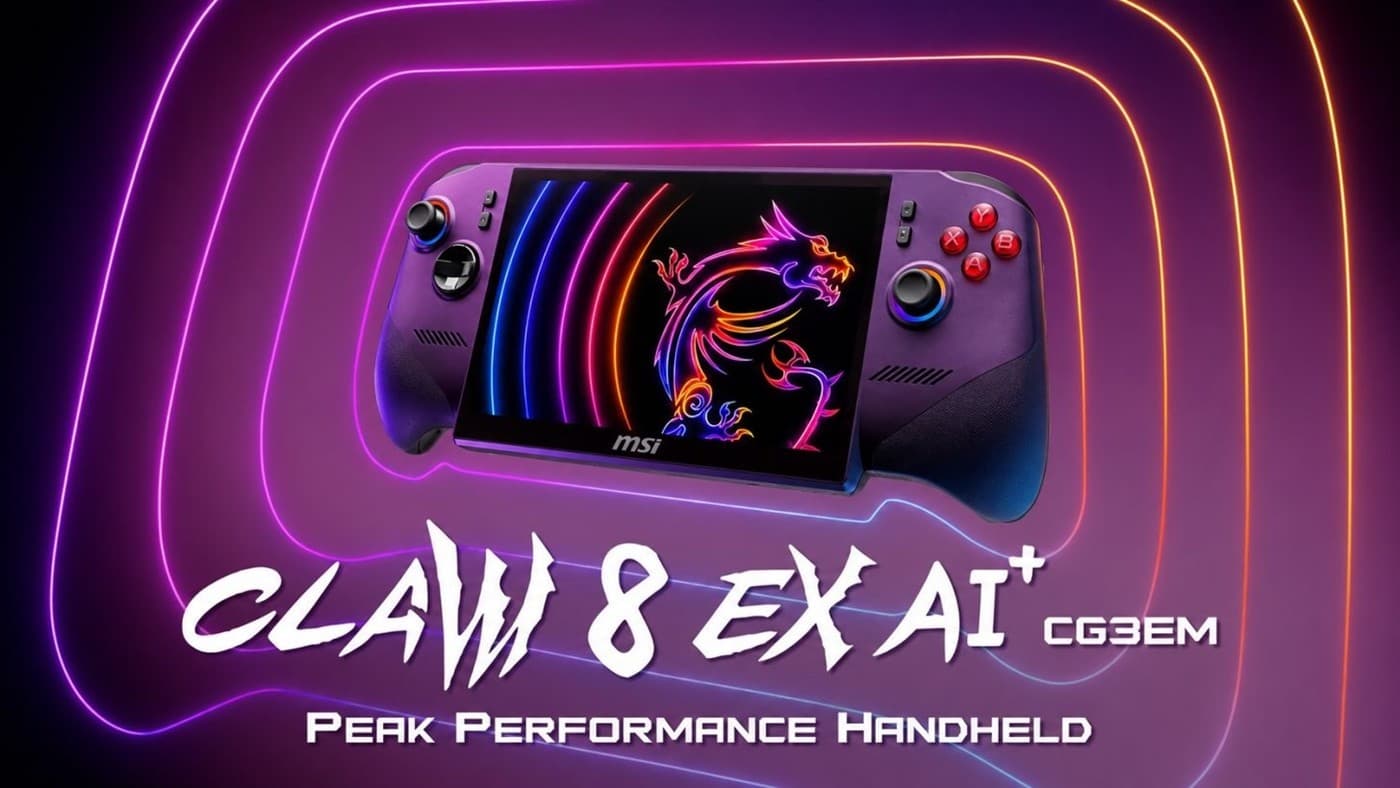
MSI has officially unveiled the Claw 8 EX AI+, a handheld gaming console built on Intel's Panther Lake platform. The device marks one of the first commercial implementations of Intel's Arc G3 Extreme graphics architecture. The announcement was made during a press event where MSI detailed the console's specifications and capabilities.
The Claw 8 EX AI+ features an 8-inch display with a 1920x1200 resolution and a 120Hz refresh rate. The screen supports touch input and is covered by Gorilla Glass for durability. Under the hood, the console is powered by an Intel Core Ultra 7 processor paired with the Arc G3 Extreme integrated GPU. MSI claims the graphics performance is comparable to entry-level discrete GPUs, enabling smooth gameplay at medium to high settings for many modern titles.
The device includes up to 32GB of LPDDR5X RAM and a 1TB PCIe Gen 4 NVMe SSD for storage. Connectivity options include Wi-Fi 7, Bluetooth 5.4, and two USB4 Type-C ports. The console also features a microSD card slot for expandable storage. MSI has equipped the Claw 8 EX AI+ with a 53Wh battery, which the company says can provide up to 6 hours of gaming on a single charge.
MSI has designed the Claw 8 EX AI+ with ergonomics in mind, featuring textured grips and Hall effect analog sticks to reduce drift. The console runs Windows 11 Home, giving users access to the full PC gaming library across platforms like Steam, Epic Games Store, and Xbox Game Pass. MSI has also included its MSI Center M software for system optimization and game management.
The Claw 8 EX AI+ is expected to compete with other handheld PCs such as the ASUS ROG Ally and Lenovo Legion Go. MSI has not yet announced pricing for the device, but it is expected to be positioned in the premium segment. The company has confirmed that the console will be available in select markets starting in the second quarter of 2025.
MSI has stated that the Claw 8 EX AI+ will ship with the latest Intel drivers optimized for the Arc G3 Extreme GPU. The company has also partnered with several game developers to ensure compatibility and performance tuning at launch. Pre-orders are expected to open in March 2025, with retail availability following in April.
MSI's announcement positions the Claw 8 EX AI+ as a high-performance handheld for gamers seeking PC-level experiences on the go. The company emphasized that the device's Panther Lake platform delivers improved power efficiency and AI capabilities compared to previous generations. MSI has not provided specific benchmark numbers but promised detailed performance data closer to the release date.