
Nvidia Unveils Cosmos 3 Open-Source Model for Physical AI and Autonomous Systems
Nvidia announced Cosmos 3, an open-source model for physical AI that integrates visual reasoning, world simulation, and action generation. The platform aims to accelerate development in robotics and autonomous vehicles.
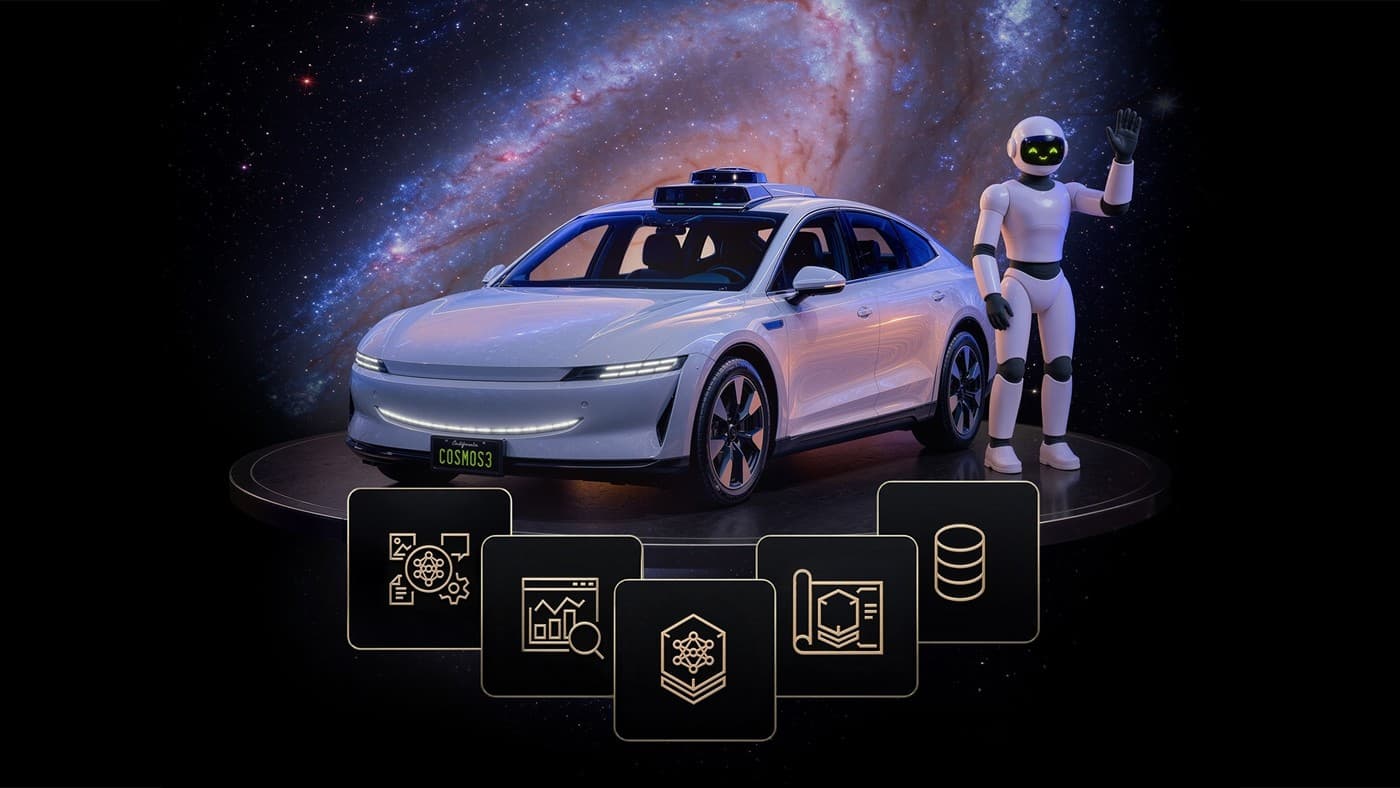
Nvidia has introduced Cosmos 3, an open-source model designed for physical artificial intelligence. The system combines visual reasoning, world simulation, and action generation into a single platform. This release targets advancements in robotics and autonomous vehicle technology.
The Cosmos 3 model processes visual data to understand environments and predict outcomes. It can simulate real-world physics and generate actions based on those simulations. Nvidia positions the platform as a tool for developers working on autonomous systems.
Nvidia frames Cosmos 3 as a step toward more capable AI in physical applications. The model is available under an open-source license, allowing researchers and companies to modify and deploy it. The company expects the platform to reduce development time for robotics and self-driving technologies.
Cosmos 3 builds on Nvidia’s previous work in AI and simulation. The model leverages the company’s expertise in GPU-accelerated computing and deep learning. Nvidia has not disclosed specific performance benchmarks or comparisons with prior versions.
The open-source release includes pre-trained models and documentation. Developers can access Cosmos 3 through Nvidia’s developer portal. The company encourages contributions from the research community to improve the model’s capabilities.
Nvidia announced Cosmos 3 at its GTC conference. The platform is available immediately for download. Pricing for enterprise support or cloud access has not been detailed.
Nvidia stated that Cosmos 3 represents a significant milestone in physical AI development. The company emphasized its commitment to open-source AI tools. Further updates and integrations are expected in future releases.
AI Weather Startup WindBorne Outperforms Government Forecasts with Balloon Data
WindBorne, an AI weather startup, now operates about 400 balloons launched from 15 sites globally to gather sensor readings. The company's forecasting model has improved by refining how balloon-collected data is integrated into its AI systems, enabling it to surpass the accuracy of government agencies.

WindBorne, an artificial intelligence-driven weather startup, has achieved forecasting accuracy that exceeds that of government meteorological agencies. The company attributes its success to a unique approach that combines proprietary model development with its own data collection infrastructure.
The startup maintains a fleet of approximately 400 balloons in flight at any given moment. These balloons are launched from 15 different sites distributed across the globe, gathering atmospheric sensor readings that feed into WindBorne's forecasting models.
Recent advances in the company's current model stem from improvements in how the data collected by the balloons is processed and integrated. By refining the data assimilation techniques, WindBorne has enhanced the accuracy of its predictions.
WindBorne's approach contrasts with traditional weather forecasting, which relies heavily on data from government-operated satellites, weather stations, and radiosondes. The startup's balloon network provides high-resolution, real-time data from regions that are often under-sampled by existing infrastructure.
The company's models leverage machine learning to interpret the balloon data and generate forecasts. This AI-driven methodology allows for more dynamic and localized predictions compared to conventional numerical weather prediction models.
WindBorne's technology has attracted attention from industries that depend on accurate weather forecasts, including agriculture, aviation, and renewable energy. The startup's ability to outperform government agencies could lead to broader adoption of its services.
The company plans to expand its balloon fleet and launch sites to further improve coverage and forecast accuracy. WindBorne's success highlights the potential of private-sector innovation in weather forecasting, a field traditionally dominated by public institutions.
WindBorne did not disclose specific accuracy metrics or pricing for its services. The startup continues to develop its technology and expand its operational footprint, with the goal of providing superior weather intelligence to commercial clients.

SoftBank to Invest €75 Billion in France's AI Infrastructure
SoftBank announced a €75 billion investment to expand France's AI infrastructure, including the construction of a 5 GW data center. The move marks one of the largest AI investments in Europe.

SoftBank has unveiled plans to invest €75 billion in France to bolster the country's artificial intelligence infrastructure. The Japanese conglomerate announced the commitment on Tuesday, positioning it as one of the largest AI-related investments in Europe. The funds will be directed toward building a massive data center with a capacity of 5 gigawatts, aimed at supporting advanced AI workloads.
The investment underscores SoftBank's aggressive push into AI infrastructure, a sector where demand for computing power has surged. The 5 GW data center is expected to be among the largest in the region, capable of powering extensive machine learning and deep learning operations. SoftBank did not specify a timeline for the project but stated that construction would begin in phases.
French President Emmanuel Macron welcomed the investment, calling it a vote of confidence in France's tech ecosystem. The government has been actively courting foreign tech investment, offering incentives for data center projects and AI research. France aims to become a European hub for AI, competing with countries like the UK and Germany.
The data center will be built in partnership with local energy providers to ensure sustainable power sources. SoftBank emphasized that the facility would incorporate energy-efficient technologies and potentially use nuclear or renewable energy, given France's low-carbon electricity grid. The company also plans to collaborate with French AI startups and research institutions.
SoftBank's investment comes amid a global race to expand AI computing capacity. Major tech firms like Microsoft, Google, and Amazon have announced multi-billion-dollar data center projects worldwide. SoftBank's commitment in France is part of its broader strategy to invest in AI, following its Vision Fund's focus on AI startups and infrastructure.
The announcement was made during the Choose France summit, an annual event aimed at attracting foreign investment. SoftBank's CEO Masayoshi Son stated that France's talent pool and energy infrastructure were key factors in the decision. The investment is expected to create thousands of jobs in construction, engineering, and AI research.
SoftBank has not disclosed the exact location of the data center, but reports suggest it could be in the Île-de-France region or near nuclear power plants in the south. The company will work with French authorities to secure permits and grid connections. The project is subject to regulatory approvals and environmental impact assessments.
The €75 billion investment is one of the largest single commitments in French tech history. It surpasses previous investments by companies like Google and Facebook in the country. SoftBank's move signals growing confidence in France's ability to host large-scale AI infrastructure, leveraging its carbon-free electricity and engineering talent.
SoftBank confirmed that the investment will be phased over several years, with the first phase expected to come online by 2028. The company will provide further details on timelines and partners in the coming months. The announcement solidifies France's position as a key destination for AI infrastructure investment in Europe.

NVIDIA Unveils Cosmos 3 AI Model for Robots and Autonomous Vehicles
NVIDIA introduced Cosmos 3, described as the world's first fully open omni-model, at the GTC Taipei event in Taiwan. The AI model supports multimodal outputs including text, images, video, and environmental audio, targeting robotics and autonomous vehicle applications.
NVIDIA made a significant announcement at the GTC Taipei event in Taiwan, unveiling what it calls the world's first fully open omni-model. The company introduced Cosmos 3, an artificial intelligence model designed to advance robotics and autonomous vehicle technology. This model integrates visual reasoning capabilities with support for multiple output modalities, including text, images, video, and environmental audio.
Cosmos 3 processes inputs from various sensors and generates outputs that can be used for training and deploying autonomous systems. The model's omni-modal architecture allows it to handle different data types simultaneously, enabling more comprehensive understanding of environments. NVIDIA positions this as a tool for developers working on robots and self-driving cars.
The model's visual reasoning ability means it can interpret scenes and make decisions based on visual data, which is critical for navigation and object interaction. By supporting environmental audio, Cosmos 3 can also incorporate sound cues, such as sirens or approaching vehicles, into its decision-making process. This multimodal approach aims to create more robust and adaptable autonomous systems.
NVIDIA emphasized that Cosmos 3 is fully open, allowing researchers and developers to access and modify the model for their specific use cases. This openness is intended to accelerate innovation in the field of embodied AI, where AI systems interact with the physical world. The company believes that shared access to such models can drive progress in robotics and autonomous driving.
The announcement was made during the GTC Taipei event, a key platform for NVIDIA to showcase its latest technologies. The company has been expanding its presence in the AI and autonomous systems sectors, with Cosmos 3 representing a significant step in its product lineup. The model builds on NVIDIA's previous work in AI and simulation technologies.
Cosmos 3 is expected to be available for download and use by the developer community. NVIDIA has not yet disclosed specific pricing or licensing details, but the open nature of the model suggests it will be freely accessible. The company plans to provide documentation and tools to facilitate integration into existing workflows.
Developers can anticipate using Cosmos 3 for tasks such as training robots to navigate complex environments or enhancing the perception systems of autonomous vehicles. The model's ability to generate multimodal outputs could also be applied in simulation environments for testing and validation. NVIDIA's announcement positions Cosmos 3 as a foundational tool for the next generation of AI-powered machines.
NVIDIA stated that Cosmos 3 is now available for developers to explore and implement in their projects. The company encourages the research community to leverage the model's capabilities to push the boundaries of what autonomous systems can achieve. Further details about the model's architecture and performance benchmarks are expected to be released in the coming weeks.
OpenAI Model Disproves Erdős Unit Distance Conjecture, Solving 80-Year-Old Math Problem
OpenAI announced that an internal AI model disproved the Erdős unit distance conjecture, a famous problem in discrete geometry unsolved for 80 years. Mathematicians including Fields Medalist Tim Gowers called it a milestone in AI mathematics.

In mid-May, OpenAI revealed that one of its internal AI models had disproved the Erdős unit distance conjecture, a longstanding problem in discrete geometry that had resisted human mathematicians for eight decades. The company provided early access to the result to several mathematicians and published their reactions online.
Tim Gowers, a recipient of the Fields Medal—mathematics' highest honor—stated that "there is no doubt that the solution to the unit-distance problem is a milestone in AI mathematics." University of Toronto professor Daniel Litt remarked that "this is the first example of a result produced autonomously by an AI that I find exciting in itself, as opposed to as a leading indicator."
The Erdős unit distance conjecture, posed by mathematician Paul Erdős in 1946, asks for the maximum number of pairs of points in a set of n points in the plane that can be exactly one unit apart. The conjecture proposed an upper bound, but the AI model found a counterexample that disproved it.
OpenAI did not disclose the specific architecture or training details of the model, but described it as a general-purpose reasoning system. The model generated the counterexample through a combination of symbolic reasoning and search, without human guidance on the problem.
The achievement marks a significant advance in AI's ability to tackle open mathematical problems. Previous AI systems have assisted in proving theorems or verifying proofs, but this is one of the first instances of an AI autonomously producing a novel result that experts find genuinely surprising.
Mathematicians who reviewed the solution confirmed its correctness. The counterexample has been formally verified, and the result is expected to be published in a peer-reviewed mathematics journal.
OpenAI plans to release further technical details about the model and the solution in a forthcoming paper. The company also intends to make the model available to researchers for exploring other open problems.
The Erdős unit distance conjecture is now resolved, with the AI's counterexample showing that the maximum number of unit distances grows faster than the conjectured bound. This result closes a chapter in discrete geometry that began nearly a century ago.