
Sony launches 1000X The Collexion to mark 10 years of flagship headphones
Sony is releasing the 1000X The Collexion, a special edition celebrating the 10th anniversary of its MDR-1000X headphones. The collection features premium materials and a higher price point.
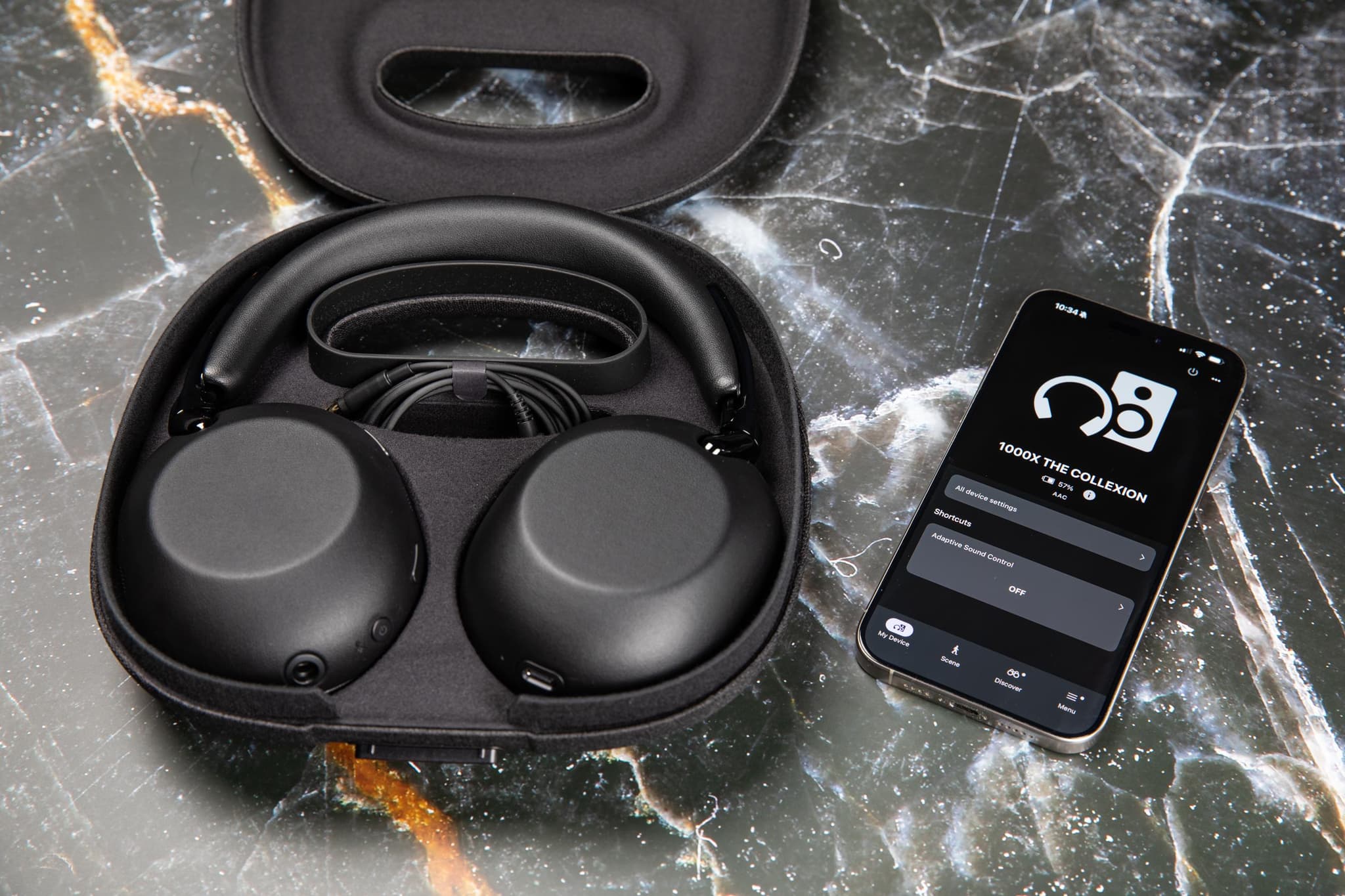
Sony introduced the MDR-1000X headphones a decade ago. That model combined noise canceling, sound quality, design, and comfort in a way that set a new standard for wireless headphones. At the time, the Bose QC35 was the closest competitor, but many found Sony's sound tuning superior. The 1000X line went on to become a benchmark in the wireless noise-canceling headphone market. Sony is now celebrating the original's launch with the 1000X The Collexion. The name's "X" references the headphones' 10-year milestone. The collection includes special editions of the WH-1000XM5 and WF-1000XM5, as well as a new carrying case and other accessories. The WH-1000XM5 in the collection features a luxurious leather finish and a unique color scheme. The WF-1000XM5 earbuds also receive a premium treatment with a metallic coating and a matching charging case. Sony says the collection uses higher-quality materials than the standard models. The 1000X The Collexion is priced at $499.99 for the over-ear headphones and $299.99 for the earbuds. That represents a significant premium over the standard versions, which retail for $349.99 and $249.99 respectively. The collection is available starting today on Sony's website and at select retailers. Sony is positioning the 1000X The Collexion as a luxury item for audiophiles and collectors. The company says it honors the legacy of the original MDR-1000X while offering an elevated experience. The standard WH-1000XM5 and WF-1000XM5 remain available at their regular prices.
Google and Volvo integrate Gemini AI with external cameras for parking sign interpretation
Google and Volvo announced at the I/O conference that Gemini will access external cameras in the upcoming Volvo EX60 SUV to interpret parking signs. The feature leverages Volvo's Android Automotive OS.

Google and Volvo announced a new integration at the I/O conference on Wednesday. The Gemini AI assistant will gain access to external cameras in the upcoming Volvo EX60 SUV. This capability will allow Gemini to interpret and explain the vehicle's surroundings to drivers.
The feature is made possible by Volvo's use of Google's embedded Android Automotive operating system. Google identified the first use case as translating difficult-to-understand parking signs. The company sees potential for additional applications in the future.
Gemini will be able to recall road signs and provide explanations to the driver. The AI assistant processes camera input to deliver real-time information. This marks a step toward more context-aware in-car assistance.
Volvo's EX60 SUV is the first vehicle to support this functionality. The integration demonstrates how Android Automotive can enable advanced AI features. Google and Volvo have collaborated on in-car technology for several years.
The announcement was made during Google's annual developer conference. No specific release date for the feature was provided. Pricing for the EX60 has not been announced.
Google envisions the camera-enabled Gemini assisting with various driving scenarios. The company emphasized the parking sign translation as an initial use case. Further details on future applications were not disclosed.
The Verge reported the news from the I/O conference. Google and Volvo did not immediately respond to requests for additional comment.
Nothing Headphone A drop to $169, lowest price yet for noise-canceling over-ears
Nothing's Headphone A, featuring active noise cancellation and a comfortable design, are now available for $169 at Amazon and Nothing's website, a $30 discount marking a new low price. The headphones retain key features of the Headphone 1 at a lower cost, with opaque colors, physical controls, and an IP52 rating.

Nothing has reduced the price of its Headphone A to $169, a $30 discount that brings the noise-canceling over-ear headphones to their lowest price yet. The deal is available at Amazon and Nothing's online storefront, where the headphones normally retail for $199. The Headphone A represent a more conventional design direction for Nothing, which has previously favored retro-transparent aesthetics and bold colors in its budget-friendly CMF line. Despite the subdued look, the Headphone A are strikingly similar to last year's Headphone 1, offering many of the same features at a significantly lower price point.
The earpieces feature a rectangular shape with oval enclosures, but use opaque colors instead of transparent housing. The headband and memory foam cups provide comfortable wear, according to testing, and physical controls manage playback, volume, noise cancellation, and other functions without capacitive buttons. The headphones carry an IP52 rating, meaning they can handle sweat and light rain, and support wired listening via USB-C and 3.5mm ports.
Sound quality out of the box can be somewhat middling, but the Nothing X app for Android and iOS offers an EQ with presets and customization options that can address this. The active noise cancellation, while not on par with more expensive sets from Sony and Bose, is effective for the price, allowing users to tune out lower frequencies using three levels or an adaptive option. However, microphone noise cancellation for calls is less effective.
The Headphone A are available now at Amazon and Nothing's website for $169, down from $199. This is a new low price for the model, which launched earlier this year. The deal is part of broader Memorial Day promotions, though no end date has been specified for this particular discount.
Nothing's Headphone A offer a solid combination of comfort, features, and noise cancellation at a competitive price point. With the current $30 discount, they present a compelling option for budget-conscious buyers seeking over-ear headphones with active noise cancellation and a distinctive design. The headphones are available in multiple opaque color options, and the deal applies to all variants at participating retailers.

Google I/O 2026 kicks off with AI, agents, and smart glasses in focus
Google I/O 2026 began at the Shoreline Amphitheatre in Mountain View, with the company expected to unveil major updates in AI search, agents, and vibe coding. Hardware announcements are not anticipated, as Google already revealed the Googlebook and Fitbit Air last week.

The Shoreline Amphitheatre in Mountain View, California, once again hosts Google I/O, the company's annual developer conference. This year's event comes as Silicon Valley is abuzz with developments in AI search, autonomous agents, vibe coding, and e-commerce, setting the stage for a slew of announcements from Google. Attendees may also catch glimpses of smart glasses demos and concept projects, though hardware is not expected to take center stage.
Google already preempted major hardware reveals last week with the introduction of the Googlebook and Fitbit Air. Additionally, much of what Android has in store was covered during the Android Show. As a result, the keynote is likely to focus heavily on software and AI advancements.
The AI landscape has shifted considerably since the last I/O, with competitors like OpenAI and Microsoft making aggressive moves. Google is expected to counter with updates to its Gemini model, deeper integration of AI into Search, and new tools for developers to build AI-powered applications.
Vibe coding, a term that has gained traction in developer circles, refers to AI-assisted programming where developers describe intent and the AI generates code. Google may unveil new capabilities in this area, potentially expanding its existing tools like Project IDX and Firebase.
E-commerce is another area where AI is making inroads. Google could announce features that leverage AI to personalize shopping experiences, improve product discovery, and streamline transactions across its platforms.
Smart glasses have been a recurring theme at past I/O events, and this year may bring more concrete demonstrations. Google's Project Astra, an AI assistant that can see and interact with the world through a camera, could be showcased in a glasses form factor.
The conference runs over two days, with the keynote being the main event. Developers and media are on-site to cover the announcements as they happen. Google typically releases developer previews and beta versions of its software during I/O.
No major hardware launches are expected during the keynote itself, as the Googlebook and Fitbit Air were already announced. However, Google may provide additional details on these products, including pricing and availability dates.
As the keynote unfolds, more details will emerge on the specific features and timelines for the announced products and services. The Verge is providing live coverage from the event.
‘Survivor’ Stars Launch Social Goal-Tracking App Paprclip
Kyle Fraser and Kamilla Karthigesu, contestants from Survivor 48, have launched Paprclip, a goal-tracking app that pairs users for accountability and shared progress. The app features daily challenges and video clips to document achievements.

Kyle Fraser, winner of Survivor 48, and fellow castmate Kamilla Karthigesu have introduced a new mobile application called Paprclip. The app reimagines goal tracking as a social experience, pairing users with accountability partners. Fraser and Karthigesu developed the concept during their time on the reality competition show.
Paprclip connects users with a partner who shares similar objectives. Each day, the app presents a challenge related to the user's goals. Partners can share short video clips documenting their progress, creating a shared timeline of achievements. The app aims to foster motivation through mutual support and friendly competition.
The idea originated from the duo's experience on Survivor, where teamwork and accountability were critical. Fraser noted that the show's environment highlighted the power of having someone to rely on. Karthigesu added that the app replicates that dynamic in a digital format.
Paprclip is available for download on iOS and Android devices. The app offers a free tier with basic features, including daily challenges and partner matching. A premium subscription, priced at $4.99 per month or $49.99 annually, unlocks additional tools such as detailed progress analytics and custom challenge creation.
Fraser and Karthigesu plan to expand the app's functionality in future updates. They are exploring features like group challenges and integration with wearable devices. The founders emphasized that Paprclip is designed for anyone seeking to achieve personal or professional goals, from fitness milestones to career objectives.
The app has already garnered attention from the Survivor fan community. Early users have praised the accountability system and the motivational aspect of sharing video updates. The founders hope to build a larger user base beyond the show's audience.
Paprclip is now live on the Apple App Store and Google Play Store. The app requires iOS 14.0 or later and Android 8.0 or higher. Users can sign up with an email address or link their social media accounts.